Centaurus A: The Galaxy with a Dusty Secret
In Brief
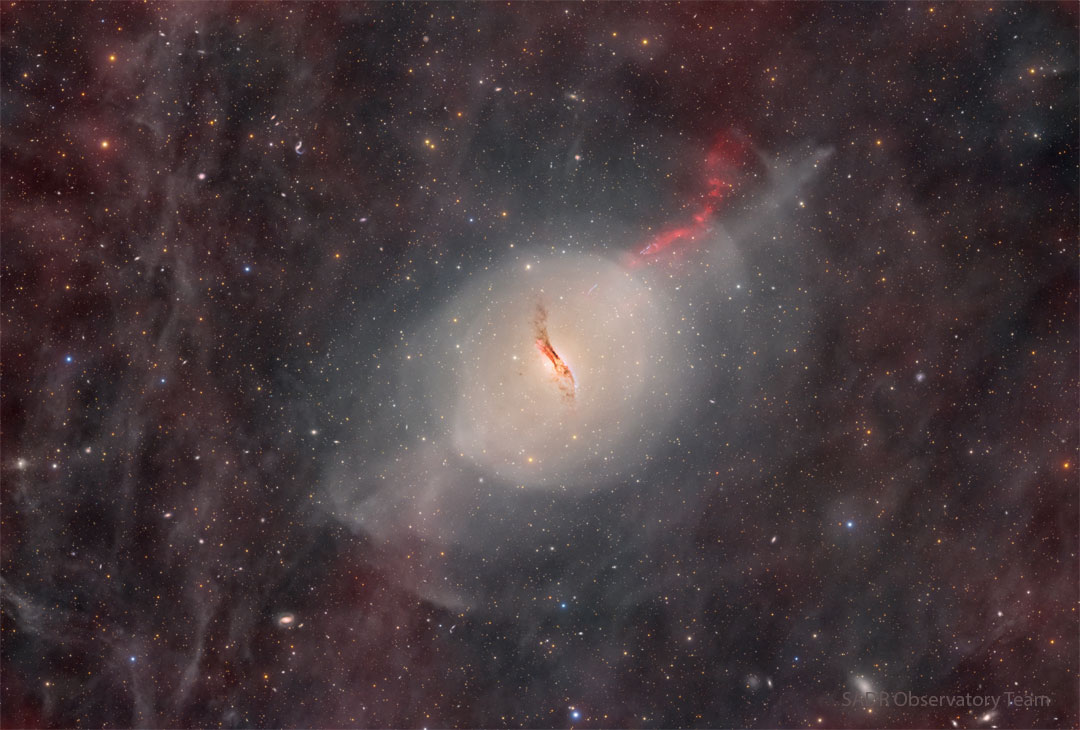
Centaurus A is a giant elliptical galaxy that defies expectations. Unlike most of its 'cleaner' cousins, it's dramatically bisected by thick dust lanes that hide its very heart. This cosmic oddity is believed to be the result of a spectacular galactic collision, making it a stellar example of how galaxies evolve and change.
The Full Story
Key Takeaways
- 1 Centaurus A is a giant elliptical galaxy with a surprisingly dusty, active center.
- 2 This dust is highly unusual for an elliptical galaxy, which are typically 'clean' and dust-free.
- 3 Scientists believe Centaurus A is the result of a massive galactic collision in the past.
- 4 The collision likely fueled a central supermassive black hole, creating a powerful jet of particles.
- 5 As the closest active galaxy, Centaurus A is a key site for studying galaxy evolution and mergers.
💡 Think of it this way:
Imagine a grand, old mansion known for its pristine, minimalist style. Then, one day, you find it unexpectedly bisected by a busy, dusty construction zone right through its main hall! That's a bit like Centaurus A – a stately elliptical galaxy with an unexpected, messy secret at its core.
How We Know This
Astronomers use powerful ground-based and space telescopes to capture incredibly detailed images of galaxies like Centaurus A. By observing how light is absorbed or emitted across different parts of the electromagnetic spectrum – especially in visible light where the dust is most apparent – they can map out the galaxy's structure, identify different populations of stars, and infer the presence and density of gas and dust. The dramatic obscuration in visible light is a crucial clue that points to the dust's extreme thickness and nature.
What This Means
Studying Centaurus A is like having a detailed crash test dummy for galactic mergers. It allows scientists to simulate and understand the complex physics involved when two galaxies collide, how new stars are triggered, and how these events impact the supermassive black holes at their cores. This knowledge is vital for refining our models of galaxy evolution and helps us predict the long-term fate of galaxies, including the ultimate collision between our own Milky Way and the Andromeda galaxy.
Why It Matters
This unusual galaxy is a cosmic laboratory, offering scientists a unique chance to study the dramatic aftermath of a galactic merger up close. Understanding Centaurus A helps us unravel the mysteries of how galaxies grow, change, and even what might happen when our own Milky Way eventually collides with Andromeda.