Back to Articles Image Of The Day

Earth's First Cosmic Hello: A Message Sent to the Stars

📖 4 min read 📊 beginner 🏷️ NASA APOD

In Brief

In 1974, scientists used the powerful Arecibo radio telescope to send a unique message, encoded in binary (1s and 0s), towards a distant cluster of stars named M13. This historic 'hello' was humanity's first deliberate attempt to communicate our existence to potential alien civilizations.
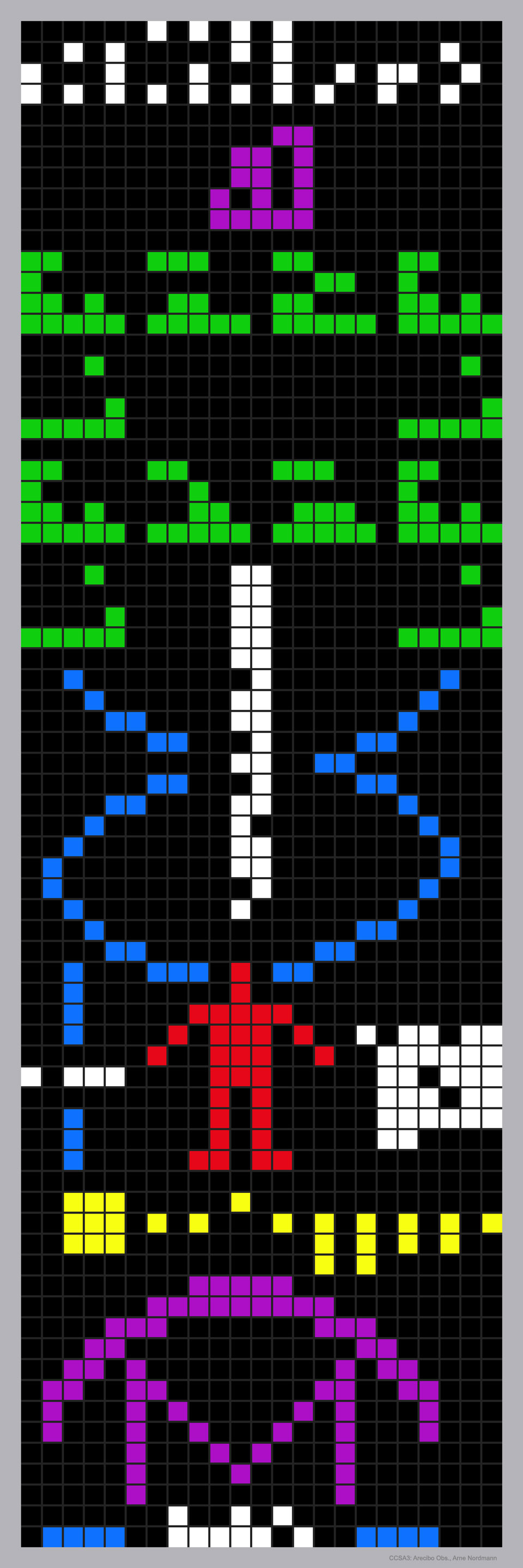
Earth's First Cosmic Hello: A Message Sent to the Stars

Disclosure: This post contains affiliate links. As an Amazon Associate, I earn from qualifying purchases.

The Full Story

Back in 1974, something extraordinary happened at the Arecibo Observatory in Puerto Rico. During the dedication of a major upgrade to what was then the world's largest single-dish radio telescope, scientists decided to do more than just celebrate – they decided to reach out to the cosmos. They broadcast a carefully designed message, not just random noise, but a coded signal meant for any intelligent beings who might be listening out in the universe. What did this cosmic message contain? It was a string of 1s and 0s, much like the binary code that runs our computers. But when these 1s and 0s are arranged correctly, they form a simple picture. This picture was a sort of cosmic résumé for humanity, displaying key information about us: numbers, the atomic elements fundamental to life on Earth, a representation of our DNA, a stick figure of a human being, our solar system with Earth highlighted, and even an image of the Arecibo telescope itself. It was our way of saying, 'This is who we are, and this is where we live.' The target for this ambitious broadcast was the globular star cluster M13, a truly ancient and densely packed collection of hundreds of thousands of stars, located about 25,000 light-years away. M13 was chosen because its high density of stars suggested a higher chance of finding worlds with intelligent life. However, because light (and radio waves) takes time to travel, the message itself will take approximately 25,000 years just to reach M13. And if there were intelligent beings there who received it and decided to reply, their answer wouldn't get back to Earth for another 25,000 years after that! The Arecibo Observatory, a marvel of engineering, was perfectly suited for this task. Its massive 1,000-foot-wide dish could not only listen for faint signals from space but also beam incredibly powerful transmissions. This dedication event was more than just a technical showcase; it was a profound moment where humanity, as a species, consciously decided to send a direct, intentional message outwards, expressing our curiosity and perhaps our loneliness in the vastness of space. While we don't expect a reply anytime soon (or perhaps ever), the Arecibo Message remains a powerful symbol of our scientific ambition and our deep-seated desire to explore the unknown. It was an act of incredible optimism, a testament to human ingenuity, and a historic step in the ongoing search for extraterrestrial intelligence (SETI). It reminds us that we are part of a much larger cosmic story, constantly wondering who else might be out there.

Key Takeaways

  • 1 Humanity sent its first direct interstellar message in 1974 from the Arecibo Observatory.
  • 2 The message was a binary code designed to convey information about Earth, humanity, and our science.
  • 3 It was aimed at the distant globular star cluster M13, 25,000 light-years away, meaning any reply would take tens of thousands of years.
Hubble Space Telescope Deep Field Poster

Hubble Space Telescope Deep Field Poster

Stunning poster featuring iconic Hubble Space Telescope imagery. Perfect for space enthusiasts.

Check Price on Amazon
*As an Amazon Associate, we earn from qualifying purchases.

💡 Think of it this way:

Imagine sending a digital postcard or a coded message-in-a-bottle across the vast cosmic ocean, hoping someone incredibly far away might one day find it, decode it, and understand your greeting.

How We Know This

The Arecibo message was created by encoding scientific and biological information into a sequence of 1s and 0s, like digital data. This binary code was then translated into radio waves and broadcast into space using the incredibly powerful dish of the Arecibo radio telescope.

What This Means

The Arecibo Message sparked widespread discussion about the ethics and implications of communicating with extraterrestrial intelligence. It solidified humanity's role in the ongoing SETI (Search for Extraterrestrial Intelligence) efforts, pushing us to consider not just listening but also actively transmitting. It highlights the immense timescales involved in interstellar communication and our persistent desire to understand our place in a potentially crowded or empty universe.

Why It Matters

This historic broadcast touches on one of humanity's deepest curiosities: Are we alone in the universe? It represents our collective hope and ambition to reach out beyond our planet and discover if other intelligent life exists.

Related Topics

#Arecibo Message #SETI #Interstellar Communication #M13 #Radio Astronomy