Cosmic Collisions: We've Heard 218 Black Hole & Neutron Star Mergers!
In Brief
Scientists have now 'heard' an incredible 218 gravitational wave signals from violent cosmic collisions between black holes and neutron stars. These ripples in spacetime, first detected in 2015, confirm a century-old prediction by Albert Einstein.
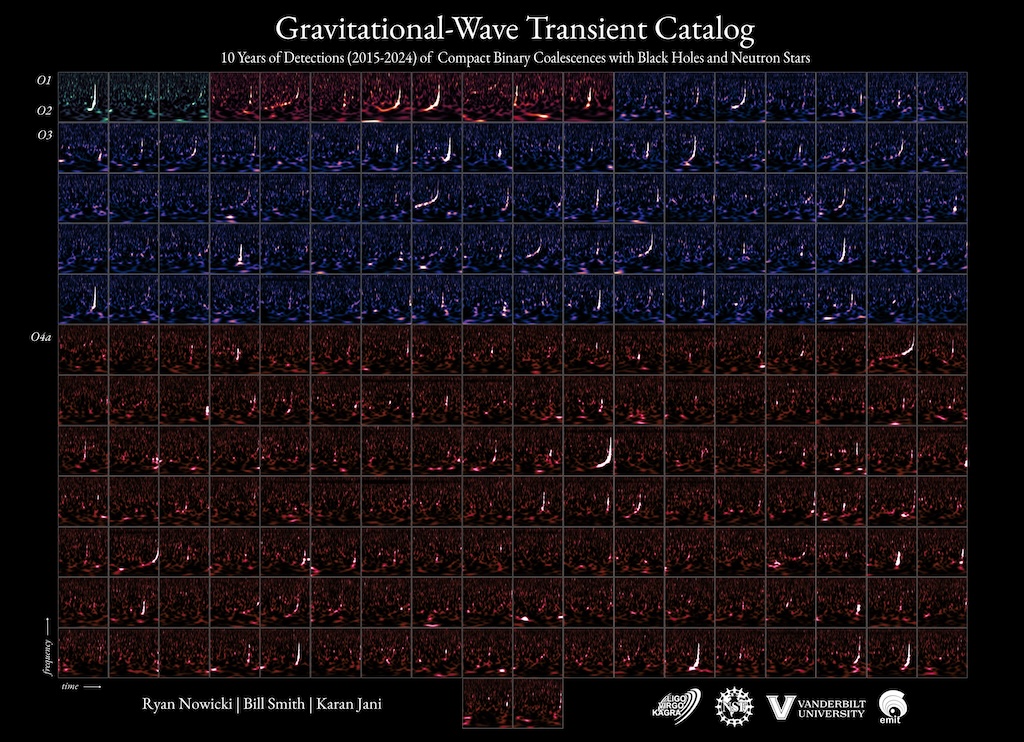
The Full Story
Key Takeaways
- 1 Scientists have detected 218 gravitational wave signals from merging black holes and neutron stars.
- 2 Gravitational waves are 'ripples' in spacetime caused by extreme cosmic events.
- 3 The detections confirm Albert Einstein's century-old prediction.
- 4 This new method of 'listening' to the universe offers unprecedented insights into its most violent phenomena.
💡 Think of it this way:
Imagine dropping two heavy bowling balls into a giant, cosmic pond and feeling the tiny ripples they create on the water – except these ripples are in the fabric of spacetime, not water!
How We Know This
The 'ears' that detect these faint whispers from space are colossal scientific instruments like the Laser Interferometer Gravitational-Wave Observatory (LIGO) in the U.S., Virgo in Italy, and KAGRA in Japan. These detectors consist of long, L-shaped tunnels with lasers bouncing back and forth. When a gravitational wave passes through Earth, it stretches and squeezes spacetime ever so slightly, creating a minuscule change in the length of these arms. The lasers detect these tiny shifts, allowing scientists to pinpoint when and where a cosmic collision occurred.
What This Means
With more detectors coming online and existing ones becoming even more sensitive, we can expect to 'hear' thousands more of these cosmic crashes in the coming years. Each detection adds a piece to the puzzle of how black holes and neutron stars form, evolve, and interact, shedding light on the life cycles of massive stars and the fundamental forces shaping our universe. This new era of gravitational wave astronomy promises to unveil previously hidden aspects of the cosmos, from the mysteries of dark matter to the very first moments after the Big Bang.
Why It Matters
This discovery gives humanity a brand new way to observe the universe's most extreme events, helping us understand the fundamental forces that shape galaxies and the very fabric of spacetime itself.