Back to Articles Image Of The Day

Ancient Statues Gaze at Our Galactic Home

📖 3 min read 📊 beginner 🏷️ NASA APOD

In Brief

Astrophotographer Rositsa Dimitrova captured the iconic mo'ai statues of Easter Island under a breathtaking clear night sky, with our Milky Way galaxy stretching overhead. This stunning image reminds us of how our ancestors used the stars for survival and culture, and why protecting dark skies is so important today.
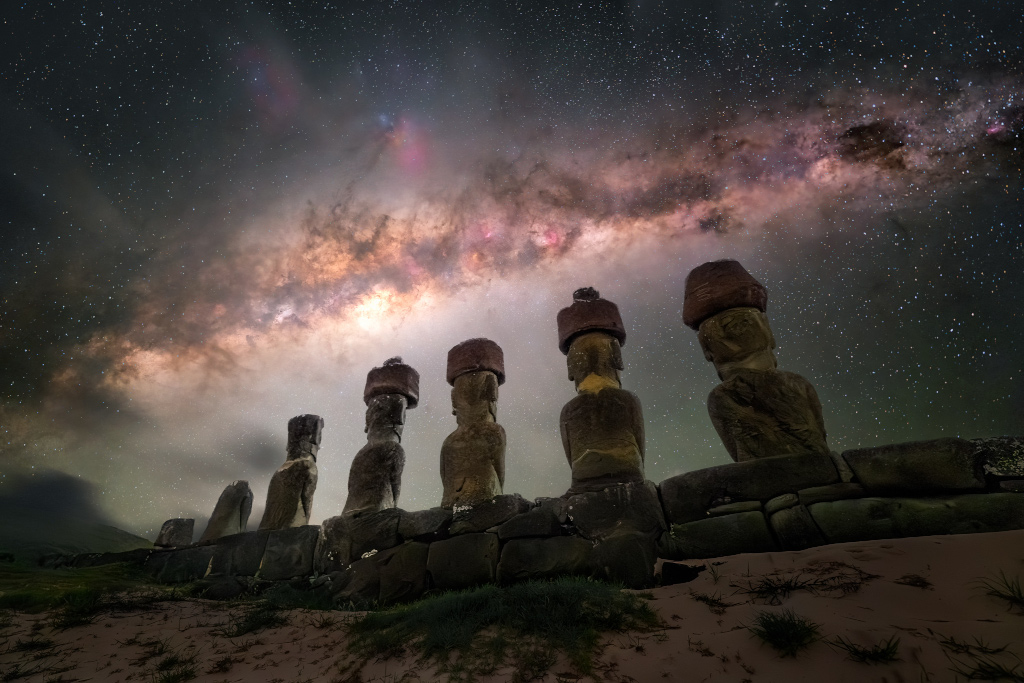
Ancient Statues Gaze at Our Galactic Home

Disclosure: This post contains affiliate links. As an Amazon Associate, I earn from qualifying purchases.

The Full Story

Imagine standing on a remote Pacific island, dwarfed by colossal stone figures, as the vibrant band of our own galaxy, the Milky Way, stretches across the sky above you. That's the breathtaking scene captured by astrophotographer Rositsa Dimitrova on Rapa Nui, also known as Easter Island. Her stunning photograph, titled "The Guardians of Rapa Nui beneath the Milky Way," invites us to ponder, as she put it, "What have these silent sentinels watched pass across the sky?" These "silent sentinels" are the famous mo'ai, monumental volcanic statues carved by the ancient Rapa Nui people. Standing guard at Ahu Tongariki, with their backs to the vast, dark Pacific Ocean, they face inland, creating a unique perspective for viewing the heavens. Because Easter Island is thousands of kilometers from any major landmass, it experiences some of the clearest, most naturally dark night skies on Earth – a perfect celestial canvas for both ancient astronomers and modern photographers. For the ancient inhabitants of Rapa Nui, the night sky was far more than a beautiful spectacle; it was a living map and calendar. Under these pristine conditions, they created sophisticated observatories and used astronomical observations for crucial aspects of their lives. The stars guided their epic canoe voyages across the Pacific, helped them calibrate their calendars for planting and harvesting, and marked the timing for important cultural celebrations and rituals. This deep connection to the cosmos was woven into the very fabric of their society. The photograph beautifully showcases the bright, hazy band of the Milky Way, our home galaxy. While parts of it appear slightly blurred by Earth's own clouds and obscured by vast, cosmic dust clouds floating between stars, its sheer brilliance is undeniable. This luminous river of stars, composed of billions of suns and gas, reminds us of our place within a much larger cosmic tapestry, a sight that has captivated humanity for millennia. Images like this serve as a powerful reminder of a precious, dwindling resource: truly dark skies. In an age where light pollution increasingly obscures our view of the cosmos, the pristine skies above Rapa Nui are a rare treasure. Protecting these dark skies isn't just about pretty pictures; it's about preserving a vital part of our natural heritage, enabling scientific research, safeguarding nocturnal wildlife, and, critically, honoring the cultural legacy of people like the Rapa Nui, whose understanding of the universe shaped their entire civilization.

Key Takeaways

  • 1 Ancient Rapa Nui people used their naturally dark skies for crucial navigation, calendar tracking, and cultural celebrations.
  • 2 The iconic mo'ai statues of Easter Island provide a unique foreground to a stunning view of our Milky Way galaxy.
  • 3 The image underscores the critical importance of preserving dark skies and protecting both natural environments and cultural heritage globally.
National Geographic Planisphere Star Finder

National Geographic Planisphere Star Finder

Essential tool for identifying constellations and stars. Perfect for beginners learning the night sky.

Check Price on Amazon
*As an Amazon Associate, we earn from qualifying purchases.

💡 Think of it this way:

Imagine looking up and seeing a sky so bright with stars, it's like a diamond-studded blanket, just as ancient mariners and civilizations did before modern city lights dimmed our cosmic view.

How We Know This

The stunning image was captured by astrophotographer Rositsa Dimitrova, who likely used specialized camera equipment and long-exposure techniques to collect enough light from the faint Milky Way and the foreground statues. The remote location of Easter Island itself is a key factor, providing naturally dark skies free from the light pollution that plagues most populated areas, which is essential for such breathtaking astronomical photography.

What This Means

This captivating image reinforces the growing global movement to preserve dark skies, encouraging efforts to reduce light pollution in urban areas and protect naturally dark regions like Easter Island. It also inspires further research into ancient astronomical practices and promotes responsible tourism that values and protects both natural and cultural heritage, ensuring future generations can also gaze upon such magnificent celestial wonders.

Why It Matters

This image connects us to ancient cultures, reveals the beauty of our universe, and highlights the global issue of light pollution, emphasizing the importance of preserving both natural environments and invaluable cultural heritage.

Related Topics

#Astrophotography #Easter Island #Milky Way #Dark Skies #Cultural Astronomy