Back to Articles Image Of The Day

Galaxy Neighbors: A Swirl and a Sphere in the Cosmic River

📖 4 min read 📊 beginner 🏷️ NASA APOD

In Brief

NASA's latest image captures two dramatically different galaxies, a grand spiral and a colossal elliptical, residing together in the distant Eridanus galaxy cluster. This cosmic 'group photo' offers a unique opportunity to study how galaxies evolve and interact across the universe.
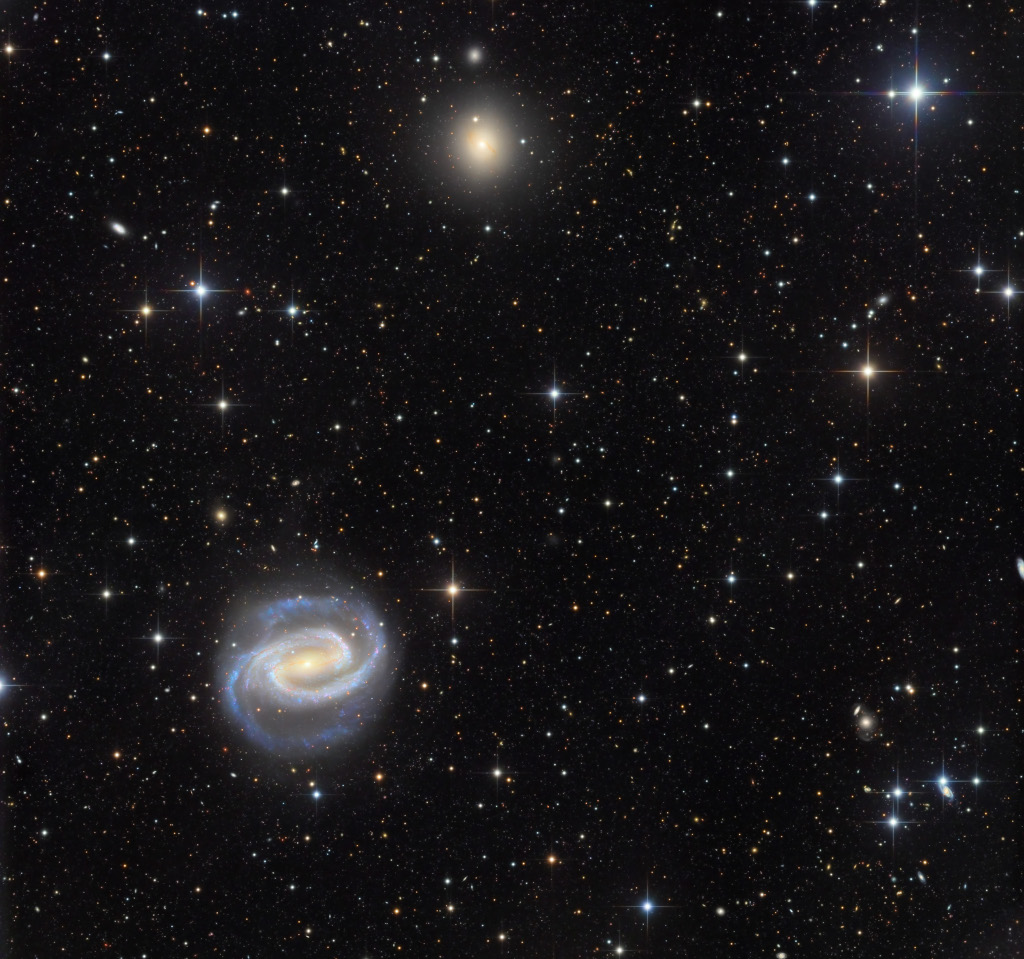
Galaxy Neighbors: A Swirl and a Sphere in the Cosmic River

Disclosure: This post contains affiliate links. As an Amazon Associate, I earn from qualifying purchases.

The Full Story

Deep within the southern constellation Eridanus, famously known as 'The River,' lies a fascinating cosmic scene featuring two remarkable galaxies: NGC 1300 and NGC 1297. While they appear to be distant neighbors, residing over 70 million light-years away, this incredible image from a powerful telescope brings them into sharp focus, showcasing their dramatic differences and shared cosmic neighborhood within the vast Eridanus Galaxy Cluster. At the lower left of our cosmic snapshot, we see NGC 1300, a breathtaking example of a barred spiral galaxy, much like our own Milky Way. Spanning an impressive 100,000 light-years across, it's presented nearly face-on, revealing its magnificent, sweeping spiral arms that gracefully wind around a prominent central bar of stars. This central bar is not just beautiful; it's thought to play a crucial role in funneling gas and dust towards the galaxy's core, where a supermassive black hole likely lurks, influencing the galaxy's dynamics and evolution. In stark contrast, near the top of the frame, is NGC 1297, a massive elliptical galaxy. Unlike the vibrant, star-forming spirals, NGC 1297 appears as a roughly spherical, somewhat hazy collection of older, reddish stars. Elliptical galaxies like this one have very little active star formation, suggesting that most of their gas and dust have already been used up or expelled. Scientists believe these cosmic giants are often the result of multiple, violent collisions and mergers between smaller spiral galaxies over billions of years, a process that reshapes them dramatically. Observing these two distinct galaxy types side-by-side in the same cluster is incredibly valuable for astronomers. It's like finding two completely different species living in the same ecosystem, allowing scientists to compare and contrast their life cycles. NGC 1300 represents a galaxy in its prime, actively forming new stars and structured by its majestic arms, while NGC 1297 offers a glimpse into a more mature, post-merger stage of galactic evolution. This 'galaxy group photo' isn't just a pretty picture; it's a window into the universe's grand narrative. By studying these celestial bodies, astronomers gain vital insights into how galaxies form, grow, and interact with each other. It helps us understand the complex processes that shape the cosmos, from the birth of stars within spiral arms to the destructive yet creative power of galactic collisions, ultimately shedding light on the destiny of all galaxies, including our own.

Key Takeaways

  • 1 Two distinct galaxies, a spiral (NGC 1300) and an elliptical (NGC 1297), are observed together.
  • 2 NGC 1300 is a barred spiral, similar to our Milky Way, with active star formation and a central black hole.
  • 3 NGC 1297 is an older elliptical galaxy, likely formed from past mergers, with little new star formation.
  • 4 Both galaxies are members of the distant Eridanus Galaxy Cluster, over 70 million light-years away.
  • 5 Comparing these contrasting galaxies helps astronomers understand how galaxies evolve and interact.
Hubble Space Telescope Deep Field Poster

Hubble Space Telescope Deep Field Poster

Stunning poster featuring iconic Hubble Space Telescope imagery. Perfect for space enthusiasts.

Check Price on Amazon
*As an Amazon Associate, we earn from qualifying purchases.

💡 Think of it this way:

Imagine observing two very different cities on the same continent: one a bustling metropolis with vibrant new construction and a clear central hub (the spiral), and the other an ancient, sprawling city, quiet and rich with history but less new development (the elliptical). Both tell a different story about how civilizations develop.

How We Know This

This stunning view was captured through advanced telescopic imaging, likely combining observations from powerful ground-based or space-based telescopes. By taking a 'group photo' of these distant galaxies, astronomers can analyze their structures, stellar populations, and relative positions to learn more about their properties and how they fit into the larger cosmic neighborhood.

What This Means

Studying such diverse galaxies in close proximity offers crucial data for refining our models of galaxy formation and evolution. This research helps us better predict the future interactions and transformations of galaxies, including the eventual merger of our own Milky Way with the Andromeda galaxy, and unravel the long-term structural development of the universe.

Why It Matters

Understanding these distant galaxies helps us piece together the puzzle of cosmic evolution, giving us clues about how our own Milky Way galaxy might have formed and what its future holds.

Related Topics

#Galaxies #Galaxy Evolution #Spiral Galaxies #Elliptical Galaxies #Eridanus Cluster