Back to Articles Image Of The Day

Spring's Grand Entrance: A Sky-Art Masterpiece from Teide Observatory

📖 3 min read 📊 beginner 🏷️ NASA APOD

In Brief

Every spring, the Sun marks a special celestial crossing called the equinox, bringing nearly equal day and night worldwide. Astronomers at Teide Observatory captured this precise moment, merging over a thousand photos to create a breathtaking image that beautifully traces the Sun's journey and the stars' dance across the sky.
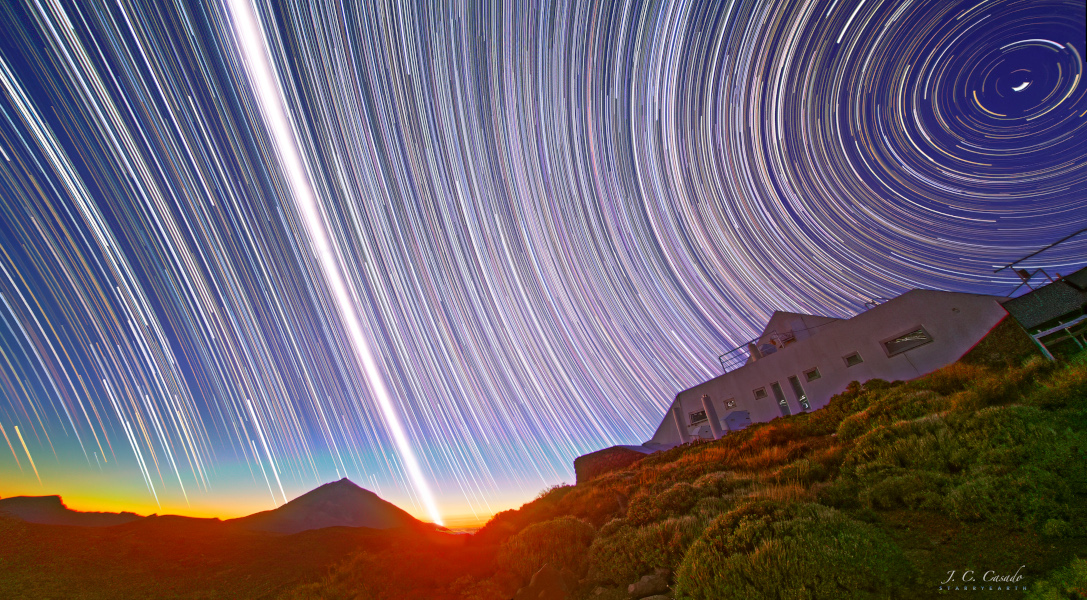
Spring's Grand Entrance: A Sky-Art Masterpiece from Teide Observatory

Disclosure: This post contains affiliate links. As an Amazon Associate, I earn from qualifying purchases.

The Full Story

The Vernal Equinox, often called the Spring Equinox in the Northern Hemisphere, is a defining astronomical moment that occurs when the Sun appears to cross an imaginary line in the sky called the celestial equator. Think of the celestial equator as Earth’s equator projected outwards into space. This year, this celestial ballet happened precisely on March 20th at 14:46 UTC, signaling the official start of spring for those above the equator and autumn for those below. During this special time, day and night are almost perfectly equal in length across the entire globe, offering a fleeting balance between light and darkness. To celebrate and capture this precise celestial alignment, astronomers at the Teide Observatory in Tenerife, Canary Islands, embarked on an ambitious photographic project. They used a special fisheye lens to take over a thousand individual images throughout the entire equinox day and night. These countless photographs were then meticulously merged, or composited, into a single, stunning skyscape. This process condenses hours of Earth’s rotation and orbital motion into one spectacular frame, creating a visual blend of science and art that lets us see time unfolding in the sky. The daytime portion of this incredible composite reveals the apparent motion of the Sun in a dramatic way. Over a continuous six-hour period, a sequence of exposures captured the Sun as it appeared to set along the celestial equator itself, forming a bright, linear, diagonal track across the sky. This visual streak isn't the Sun actually moving; instead, it's our planet Earth rotating and orbiting, creating the illusion of the Sun moving against the backdrop of distant stars. It’s a vivid, tangible representation of our planet's daily spin and yearly journey around our star. Once the Sun dipped below the horizon, the camera continued its work, recording the mesmerizing trails of stars as Earth kept turning. These nighttime exposures show the celestial equator as another straight linear track, while distant stars form concentric arcs, circling around the North Celestial Pole (visible near the bright star Polaris in the upper right of the image) and the South Celestial Pole (just beyond the lower left edge, below the horizon). In the foreground, the majestic Teide volcano peak and the observatory’s distinct pyramid-shaped solar laboratory building ground this cosmic spectacle to our planet, reminding us that even as the heavens dance, we are firmly rooted on Earth.

Key Takeaways

  • 1 The Spring Equinox marks the Sun's special crossing of the celestial equator, bringing nearly equal day and night worldwide.
  • 2 An incredible composite image from Teide Observatory merges over 1,000 photos to visualize both the Sun's daytime path and the stars' nighttime trails.
  • 3 This stunning sky-art piece beautifully illustrates Earth's orbital journey around the Sun and its daily rotation, making abstract astronomy tangible and inspiring.
National Geographic Planisphere Star Finder

National Geographic Planisphere Star Finder

Essential tool for identifying constellations and stars. Perfect for beginners learning the night sky.

Check Price on Amazon
*As an Amazon Associate, we earn from qualifying purchases.

đź’ˇ Think of it this way:

Imagine drawing the exact path of the Sun and stars across the sky in one continuous masterpiece – this image is exactly that, a cosmic time-lapse art piece!

How We Know This

Astronomers at the Teide Observatory used a specialized fisheye lens to capture over a thousand individual photographs throughout the equinox day and night. These images were then digitally merged to create a single, breathtaking skyscape that compresses hours of celestial motion into one frame, showcasing the Sun's path and star trails simultaneously.

What This Means

While equinoxes are predictable celestial events, capturing them in such artistic and detailed ways helps us profoundly appreciate Earth's cosmic dance. These images serve as powerful educational tools, making complex astronomical concepts like our planet's tilt and orbit visible and understandable to everyone, inspiring wonder and a deeper connection to our place in the universe. They remind us of the continuous, beautiful mechanics governing our world.

Why It Matters

This annual celestial event isn't just a date on the calendar; it directly impacts our seasons, daylight hours, and even how we celebrate spring or autumn, connecting everyone on Earth to our planet's cosmic journey around the Sun.

Related Topics

#Astronomy #Equinox #Seasons #Earth #Photography #Skygazing