Back to Articles Image Of The Day

Cygnus: A Cosmic Firestorm Lights Up the Night Sky

📖 3 min read 📊 beginner 🏷️ NASA APOD

In Brief

A breathtaking image from Spain captures the Cygnus region, a massive cosmic nursery where new stars are being born. This composite photograph reveals hidden colors and intricate details of glowing gas and dark dust clouds, far beyond what our eyes can perceive.
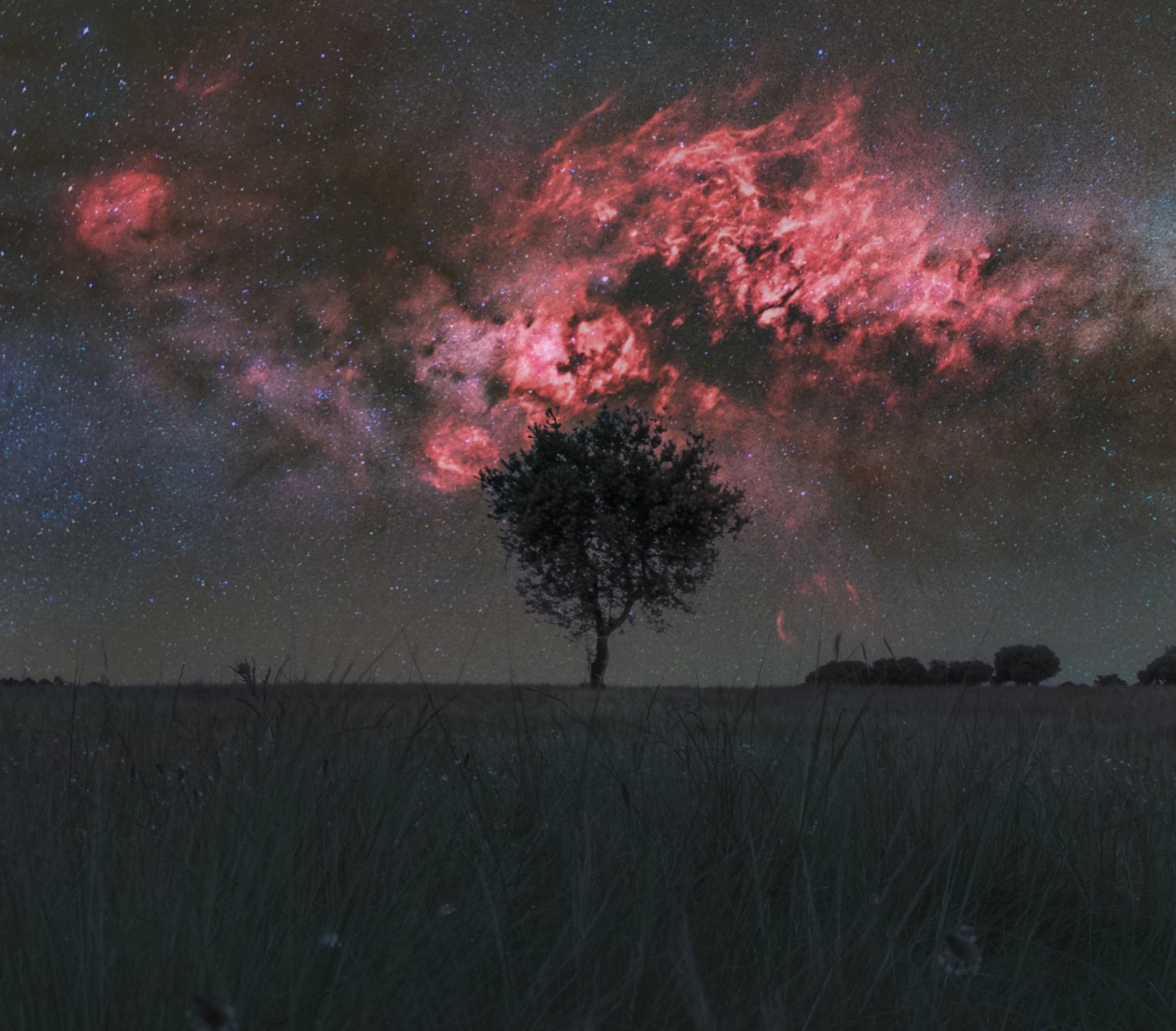
Cygnus: A Cosmic Firestorm Lights Up the Night Sky

Disclosure: This post contains affiliate links. As an Amazon Associate, I earn from qualifying purchases.

The Full Story

Picture a tranquil meadow in Guadalajara, Spain, where a single tree stands silhouetted against a sky ablaze with celestial fire. This stunning image isn't just a pretty picture; it's a window into the heart of the Cygnus constellation, a dynamic region of our Milky Way galaxy pulsing with the energy of new beginnings. It shows us how stars are born and the dazzling artistry of the cosmos. What causes this cosmic blaze? Cygnus is a giant stellar nursery, where colossal clouds of gas and dust are collapsing under their own immense gravity. As these clouds get denser, their cores heat up until a process called nuclear fusion ignites – and a new star is born! These newborn stars then blast out energy, causing surrounding hydrogen gas to glow a vibrant crimson, like a celestial neon sign. Dark lanes weaving through the brightness are vast clouds of interstellar dust, absorbing some of that starlight and casting long, intricate shadows across the cosmic landscape. Our human eyes, while amazing, can only catch a glimpse of the universe's true splendor. This photograph, however, is a sophisticated composite of multiple exposures. Think of it like taking many pictures with different filters and over extended periods, and then expertly layering them to bring out colors and brightness levels that are too faint or outside our visual spectrum to see directly. The result is a vibrant tapestry, spanning an area over a thousand times wider than a full moon, revealing Cygnus in all its fiery glory. Beyond its stellar nurseries, Cygnus is a veritable treasure chest of celestial wonders. It's home to famous nebulae – vast clouds of gas and dust – with evocative names like the Veil, the Crescent, and the Pelican, each a spectacular artwork in its own right. But perhaps its most famous resident is Cygnus X-1, a mind-bending object that was the very first black hole ever confirmed by scientists. Here, gravity is so incredibly powerful that nothing, not even light, can escape its grasp. Cygnus isn't just a pretty face; it's a living laboratory for astronomers. Scientists continue to unlock its secrets, like the recent breakthrough in creating a new three-dimensional model of the Cygnus Loop, a supernova remnant. This was made possible by the incredible insights from the Chandra X-ray Observatory, which peers at the universe in X-ray light, revealing high-energy phenomena invisible to optical telescopes. Each new discovery in Cygnus deepens our understanding of how stars live and die, how galaxies evolve, and ultimately, how our own solar system came to be.

Key Takeaways

  • 1 Cygnus is a massive, active region of star formation, captured in stunning detail.
  • 2 Advanced astrophotography reveals colors and structures in Cygnus invisible to the naked eye.
  • 3 The constellation hosts iconic cosmic objects, including nebulae and Cygnus X-1, the first confirmed black hole.
National Geographic Planisphere Star Finder

National Geographic Planisphere Star Finder

Essential tool for identifying constellations and stars. Perfect for beginners learning the night sky.

Check Price on Amazon
*As an Amazon Associate, we earn from qualifying purchases.

💡 Think of it this way:

Imagine a vast, distant fireworks factory constantly igniting new, brilliant displays across the sky – that's what's happening in Cygnus, but on an unimaginable, truly cosmic scale.

How We Know This

This captivating image is a 'composite of exposures,' meaning many photographs taken over time and sometimes with special filters were combined. This allows astronomers to capture faint light and reveal colors our eyes can't see. For specific discoveries like the 3D model of the Cygnus Loop, observatories like the Chandra X-ray Observatory are used. These telescopes detect different types of light (like X-rays) that reveal high-energy phenomena in space.

What This Means

Studying dynamic regions like Cygnus helps us understand the birth, life, and death cycles of stars, including our own Sun. It provides crucial clues about the formation of planets, the evolution of galaxies, and the fundamental physics governing our universe. Future observations will continue to unravel more mysteries about stellar nurseries and extreme cosmic objects, pushing the boundaries of our knowledge.

Why It Matters

Understanding how stars like our Sun are born helps us grasp our place in the universe and the incredible processes that shaped our galaxy. It's a stunning peek into the building blocks of everything we know, from planets to people.

Related Topics

#Cygnus #Star Formation #Nebulae #Black Holes #Astrophotography