Moonlit Ballet: Earth's Spin Captures Star Trails & Lunar Eclipse
In Brief
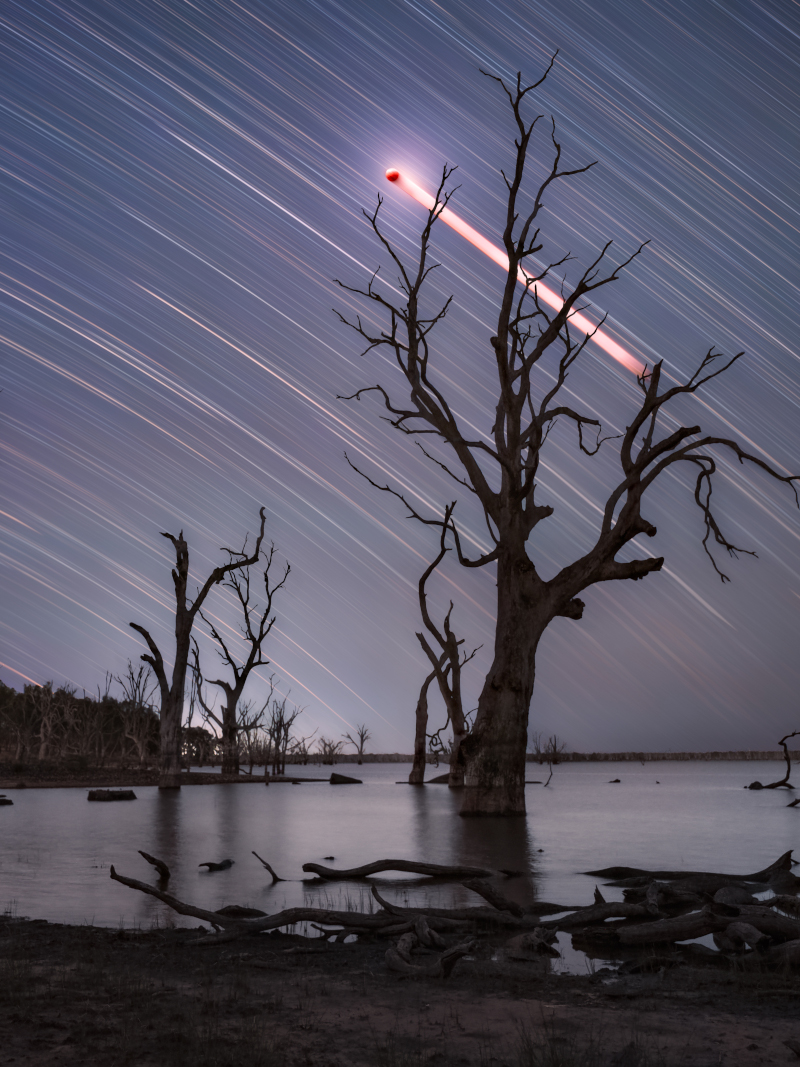
This breathtaking photo from Australia beautifully captures how our Earth's constant rotation makes stars and the eclipsed Moon appear to create graceful streaks across the night sky. It's a unique blend of a total lunar eclipse with stunning star trails, revealing the subtle dance of our home planet in the cosmos.
The Full Story
Key Takeaways
- 1 The image showcases star trails and a Moon trail, which are visual records of Earth's daily rotation.
- 2 It captures a total lunar eclipse, revealing the Moon's distinct reddish glow as it moved across the darkened sky.
- 3 Advanced astrophotography techniques, like stacking multiple exposures, were used to create this unique composite image.
💡 Think of it this way:
Imagine you're at a fun fair, spinning slowly on a carousel with a glow stick in your hand. From your perspective, the lights and rides around you seem to swirl and streak. This photo captures that same 'swirling' effect, but with stars and the Moon as Earth is our grand carousel!
How We Know This
This stunning composite image wasn't created with a simple point-and-shoot! Astrophotographers use specialized techniques like 'long-exposure photography' and 'image stacking.' They set their camera on a tripod, point it at the sky, and take many photos over an extended period – sometimes hours. Each photo captures a tiny segment of the stars' and Moon's movement. Then, using computer software, these individual frames are digitally combined, or 'stacked,' to create the beautiful, continuous light trails you see. For the crisp, detailed Moon at the end of its trail, a separate, close-up shot was taken with a powerful 'telephoto lens' and then seamlessly blended into the larger scene.
What This Means
Beyond its artistic appeal, this kind of astrophotography provides a tangible way for everyone to understand complex astronomical phenomena, like Earth's rotation and lunar eclipses. It inspires wonder and curiosity about our universe, encouraging more people to look up and learn. For aspiring photographers and scientists alike, it highlights the power of combining technology and creativity to reveal the hidden beauty and mechanics of our cosmos, fostering new innovations in visual science communication.
Why It Matters
This image isn't just a stunning display; it's a profound visual lesson about our place in the universe. It helps us truly see and understand Earth's daily rotation, a fundamental astronomical concept, in a way that's both beautiful and easily grasped by everyone.