Back to Articles Image Of The Day

Cosmic 'Monster' Unmasked: A Stellar Nursery, Not a Galaxy Gobbler!

📖 4 min read 📊 beginner 🏷️ NASA APOD

In Brief

A stunning new image reveals a cosmic structure resembling a menacing monster, but it's actually a gigantic cloud of gas and dust called CG 4, where new stars are being born. This 'cometary globule' is safely located in our own galaxy, far from a beautiful spiral galaxy seen hundreds of millions of light-years beyond it.
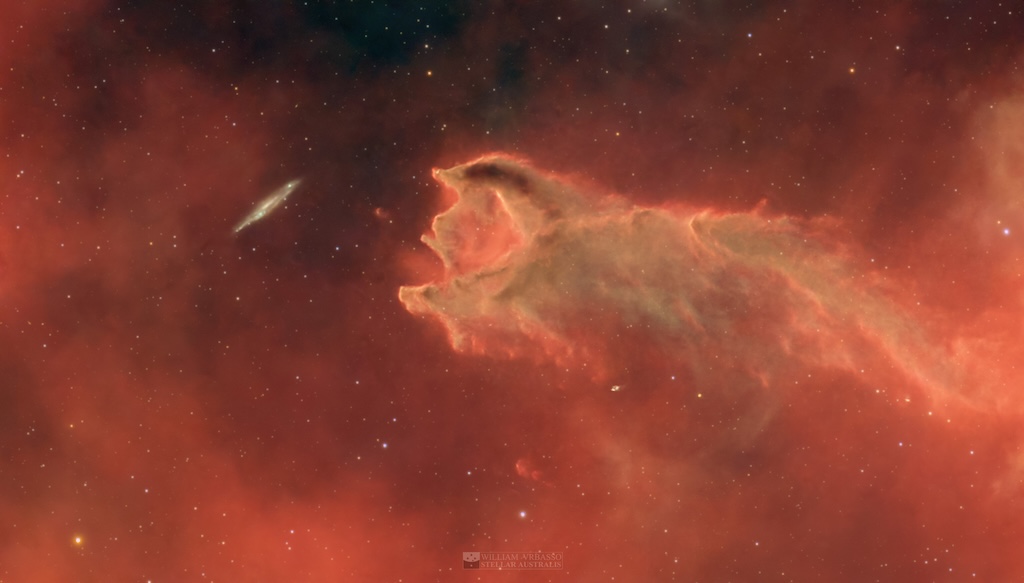
Cosmic 'Monster' Unmasked: A Stellar Nursery, Not a Galaxy Gobbler!

Disclosure: This post contains affiliate links. As an Amazon Associate, I earn from qualifying purchases.

The Full Story

From a distance, the glowing red shape in our cosmic image looks like a fearsome beast, complete with an open mouth, ready to devour a distant galaxy. Thankfully, this is just a spectacular trick of perspective and light! What we're actually seeing is a fascinating celestial object known as Cometary Globule CG 4, a vast cloud of gas and dust located a mere 1,300 light-years away in the constellation Puppis. CG 4 is not a monster, but rather a 'molecular cloud' – essentially a cosmic nursery where new stars are forming. Within these frigid, dense clouds, hydrogen atoms get cold enough to link up and form molecules. Gravity then starts to pull these molecules together, slowly but surely gathering enough material to ignite and form brand-new stars. It's a crucial stage in the stellar lifecycle, demonstrating how the building blocks of the universe come together to create luminous new suns. The unique shape of CG 4, resembling a comet with a bright head and a long tail, is truly colossal. Its 'head' alone spans about 1.5 light-years across – for context, the distance from Earth to our own Sun is only about 8 *light-minutes*. Its wispy 'tail' stretches an incredible 8 light-years into space! Scientists believe this distinctive shape was carved out by powerful cosmic forces, likely the shockwaves from a nearby supernova explosion or the intense radiation streaming from very hot, massive stars. Indeed, CG 4 and its neighboring globules seem to point away from the Vela Supernova Remnant, a leftover from an ancient stellar explosion. Now, about that 'unsuspecting galaxy' in the background: it's an edge-on spiral galaxy named ESO 257-19. While it appears to be right in the monster's path, it's actually incredibly far away – more than a hundred million light-years *beyond* CG 4. This vast separation means the galaxy is completely safe from the 'monster's' clutches. It's a powerful reminder of the immense distances in space and how images can sometimes compress unrelated objects into a single, dramatic scene. Understanding objects like CG 4 is vital for astronomers. By studying these stellar nurseries, we gain crucial insights into the conditions required for star formation, the processes that shape nebulae, and how the powerful events like supernovae can influence their surroundings. It helps us piece together the grand story of how galaxies evolve and how new generations of stars, and potentially planets, come into being.

Key Takeaways

  • 1 The 'cosmic monster' is actually Cometary Globule CG 4, a cloud where new stars are forming.
  • 2 CG 4 is a 'stellar nursery' where cold hydrogen molecules are pulled together by gravity to create stars.
  • 3 Its comet-like shape, with a head 1.5 light-years wide and a tail 8 light-years long, was likely sculpted by a supernova or massive stars.
  • 4 The distant spiral galaxy in the image is hundreds of millions of light-years *behind* CG 4 and is completely safe.
  • 5 This discovery helps us understand star formation and the vast, often deceptive, scales of the universe.
Hubble Space Telescope Deep Field Poster

Hubble Space Telescope Deep Field Poster

Stunning poster featuring iconic Hubble Space Telescope imagery. Perfect for space enthusiasts.

Check Price on Amazon
*As an Amazon Associate, we earn from qualifying purchases.

💡 Think of it this way:

Imagine seeing a tiny, menacing shadow on your window from a leaf, while a huge, distant mountain range appears in the background. The 'monster' is just the leaf, much closer and harmless, while the 'mountain range' is the truly distant, unrelated galaxy.

How We Know This

Astronomers use powerful telescopes to capture these breathtaking images, gathering light from distant objects. By analyzing the colors and patterns of this light, they can determine the composition, temperature, and movement of cosmic clouds like CG 4. This allows them to effectively 'see' through vast cosmic distances and understand the physical processes occurring there.

What This Means

Future studies of cometary globules like CG 4 will help refine our models of star formation, shedding more light on how young stars acquire their mass and how their environment influences their development. Understanding these structures also provides clues about the history of powerful events like supernovae within our galaxy and how they sculpt the interstellar medium, ultimately affecting where and when new stars can be born. It's like finding a missing piece in the puzzle of cosmic evolution.

Why It Matters

This discovery helps us unravel the mysteries of star birth across the universe and reminds us how immense cosmic distances can create incredible illusions. It's a peek into the raw, powerful processes that shape our cosmos.

Related Topics

#Star Formation #Molecular Clouds #Nebulae #Astrophysics #Cosmic Illusions