Eclipse Twins: Why Lunar Spectacles Repeat Every 18 Years
In Brief
Ever wonder why some lunar eclipses look like cosmic déjà vu? Recent images of a total lunar eclipse in March 2026 appear almost identical to one from February 2008. This isn't a coincidence; it's due to the Saros cycle, an ancient discovery that predicts when the Sun, Earth, and Moon align perfectly for a repeating eclipse.
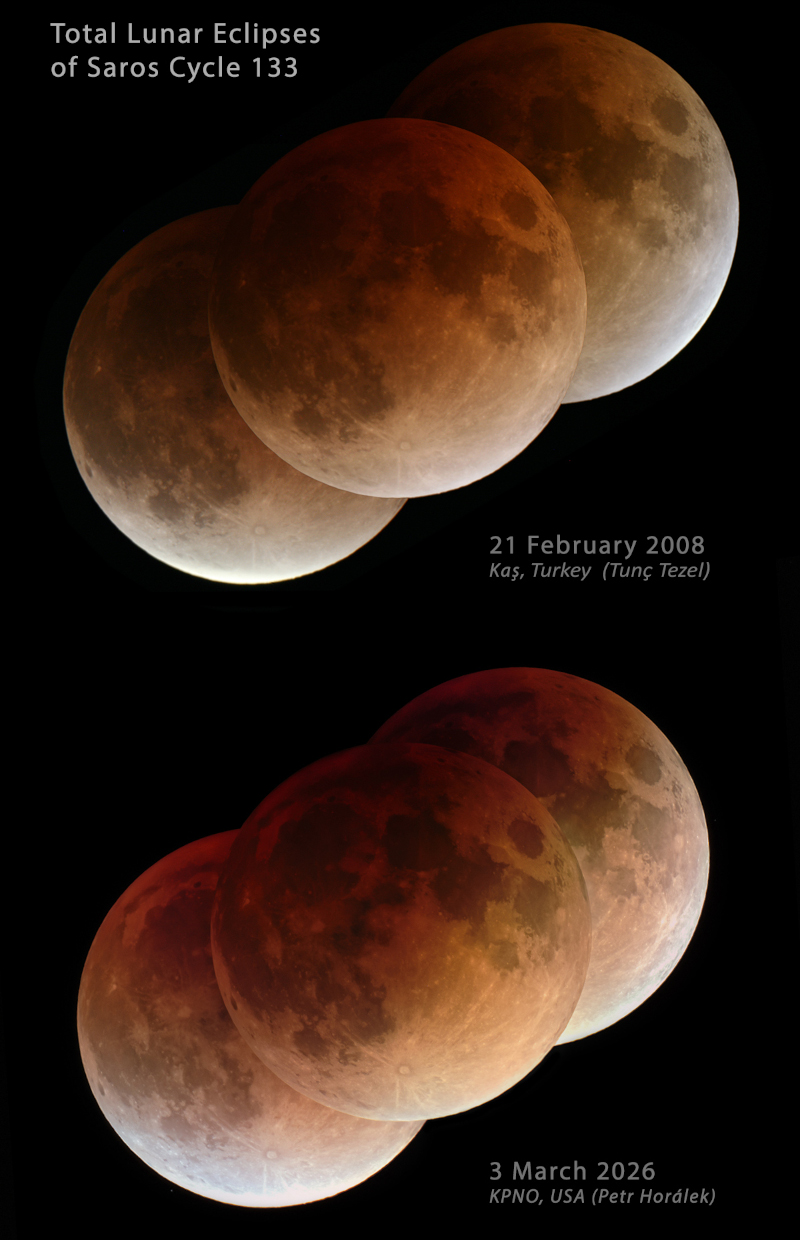
The Full Story
Key Takeaways
- 1 Total lunar eclipses can appear nearly identical even decades apart.
- 2 The Saros cycle, lasting 18 years, 11 and 1/3 days, predicts when eclipses will repeat.
- 3 This ancient astronomical discovery reveals the predictable orbital dance of the Sun, Earth, and Moon.
💡 Think of it this way:
Think of it like a cosmic clock where the Sun, Earth, and Moon's hands align perfectly every 18 years, 11 and 1/3 days, to strike 'eclipse' – a celestial performance on a reliable schedule.
How We Know This
The Saros cycle wasn't discovered with high-tech telescopes or computers, but through centuries of meticulous observation by ancient astronomers. By carefully charting the Moon's path, timing eclipses, and noticing patterns in their occurrence, they identified this precise recurring rhythm in the celestial dance of the Sun, Earth, and Moon.
What This Means
The Saros cycle continues to be a fundamental tool for predicting eclipses far into the future, enabling astronomers and sky-watchers alike to anticipate and plan for these spectacular celestial events. It underscores our ability to model and understand the universe's clockwork precision, inviting generations to come to witness the cosmos' beautiful, repeating performances.
Why It Matters
Understanding the Saros cycle allows us to predict eclipses with incredible accuracy, demonstrating humanity's long-standing ability to decipher the complex dance of celestial bodies. It's a testament to ancient astronomy and a reminder of the universe's predictable rhythms, letting us mark our calendars for future sky shows.