Back to Articles Image Of The Day

Earth Paints the Moon Red: A Cosmic Show Over Sacred Lands

📖 3 min read 📊 beginner 🏷️ NASA APOD

In Brief

Earlier this week, the full Moon turned a spectacular shade of red during a total lunar eclipse, the only one of the year. This dazzling event occurs when Earth's shadow completely covers the Moon, filtering sunlight through our atmosphere to cast a fiery glow.
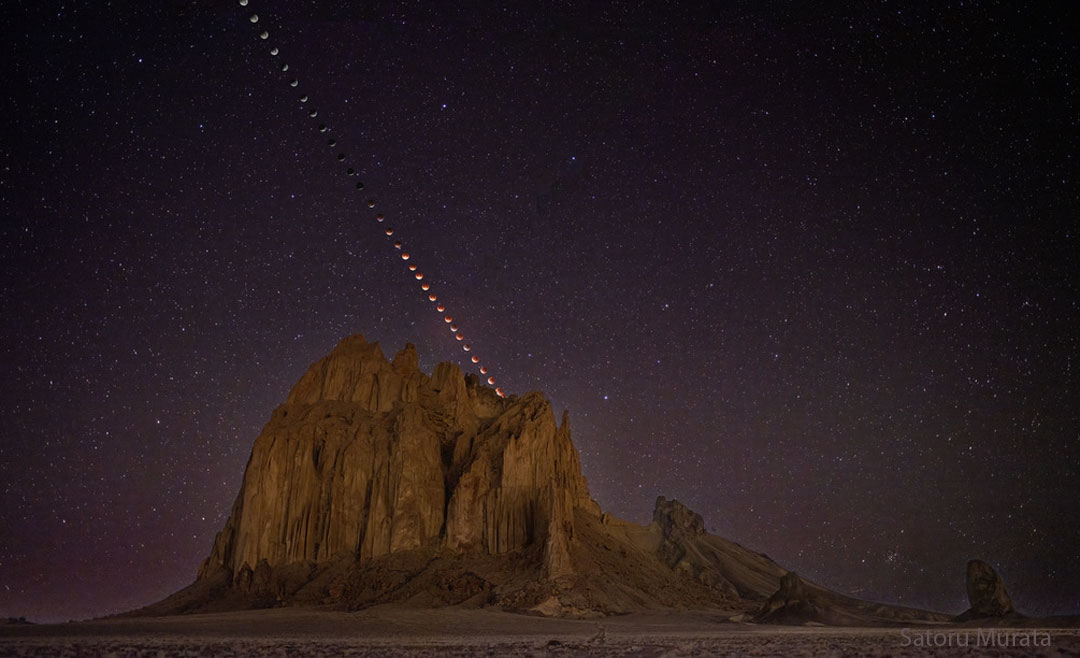
Earth Paints the Moon Red: A Cosmic Show Over Sacred Lands

Disclosure: This post contains affiliate links. As an Amazon Associate, I earn from qualifying purchases.

The Full Story

Imagine the night sky ablaze with a rare and beautiful spectacle: the full Moon, usually a brilliant pearl, slowly transforming into a glowing ember. Earlier this week, sky-watchers around the globe witnessed this magic during the year's only total lunar eclipse. This captivating celestial dance saw Earth's vast shadow sweep across our lunar neighbor, culminating in a breathtaking deep red hue. Captured in stunning sequence, these images tell the story of the Moon's journey through our planet's shadow, with the majestic Tsé Bit'a'í (Shiprock) in Navajo Nation providing an earthly anchor to this cosmic event. So, why does the Moon turn red during an eclipse? It's all thanks to Earth's atmosphere. As sunlight makes its way towards the Moon during an eclipse, it first has to pass through our planet's air. Think of our atmosphere like a giant filter, similar to how sunsets appear red or orange. Shorter wavelengths of light, like blue and green, are scattered away by the molecules in our atmosphere – this is why our sky looks blue! The longer wavelengths, like red, orange, and yellow, penetrate through and are bent, or 'refracted,' towards the Moon, painting its surface with those fiery, beautiful tones. This dramatic phenomenon gives the eclipsed Moon its famous 'Blood Moon' appearance. The striking photographs of this eclipse are made even more poignant by their foreground: Tsé Bit'a'í, or Shiprock, a towering volcanic formation located within Navajo Nation. Known as 'rock with wings,' Tsé Bit'a'í is not just a geological wonder; it's a sacred monument deeply embedded in Navajo oral traditions. It features prominently in their origin stories, tales of adventure, and heroic legends, making it a powerful symbol of connection between earth and sky. Framing this rare celestial event with such a culturally significant landmark beautifully intertwines the scientific marvel with profound cultural heritage. Beyond its visual splendor and scientific explanation, this total lunar eclipse held significant cultural weight. As the first full moon of the lunar new year, it carried special meaning for many cultures worldwide, symbolizing new beginnings and celestial alignment. Its visibility spanned a vast swath of the globe, from East Asia across North America, allowing countless observers to witness the same breathtaking spectacle. This shared experience, despite great distances, served as a powerful reminder that no matter where we are on Earth, we are all united under the same magnificent sky, looking up at the same celestial canvas. The year's only total lunar eclipse was more than just an astronomical event; it was a global moment of connection, wonder, and cultural resonance. It offered a vivid demonstration of how Earth, Moon, and Sun interact, filtered through the lens of our own planet's atmosphere. Such events not only deepen our understanding of the cosmos but also remind us of the enduring beauty of our natural world and the rich tapestry of human stories and traditions that have long looked to the heavens for inspiration.

Key Takeaways

  • 1 Earth's atmosphere filters sunlight, causing the Moon to glow red during a total lunar eclipse.
  • 2 The eclipse was beautifully captured over Tsé Bit'a'í (Shiprock), a sacred landmark in Navajo Nation, connecting the cosmos with rich cultural heritage.
  • 3 Visible across continents, this celestial event united people globally, serving as a powerful reminder that we all share the same sky.
National Geographic Planisphere Star Finder

National Geographic Planisphere Star Finder

Essential tool for identifying constellations and stars. Perfect for beginners learning the night sky.

Check Price on Amazon
*As an Amazon Associate, we earn from qualifying purchases.

💡 Think of it this way:

Think of it like our atmosphere acting as a giant filter, letting only the red light from a sunset reach the Moon.

How We Know This

The stunning sequence of images was created by combining multiple photographs of the Moon taken over time. As the eclipse progressed, each picture captured our planet's shadow gradually engulfing the Moon, showcasing its journey and dramatic color change. This photographic technique allows observers to illustrate the dynamic nature of celestial events in a single, compelling composition.

What This Means

While lunar eclipses are predictable and natural phenomena, their occurrence consistently inspires a sense of wonder and curiosity. These events provide opportunities for public engagement in astronomy, encouraging people of all ages to observe and appreciate the mechanics of our solar system. For scientists, observing eclipses can offer subtle data points, but for the general public, they serve as potent cosmic reminders that we are part of a larger, interconnected universe, fostering a shared appreciation for the celestial ballet above us.

Why It Matters

It's a beautiful reminder of our place in the solar system, connecting us to ancient cultures and fellow sky-watchers across the globe, uniting us under the same shared sky.

Related Topics

#Lunar Eclipse #Astronomy #Shiprock #Navajo Culture #Earth's Atmosphere