Back to Articles Image Of The Day

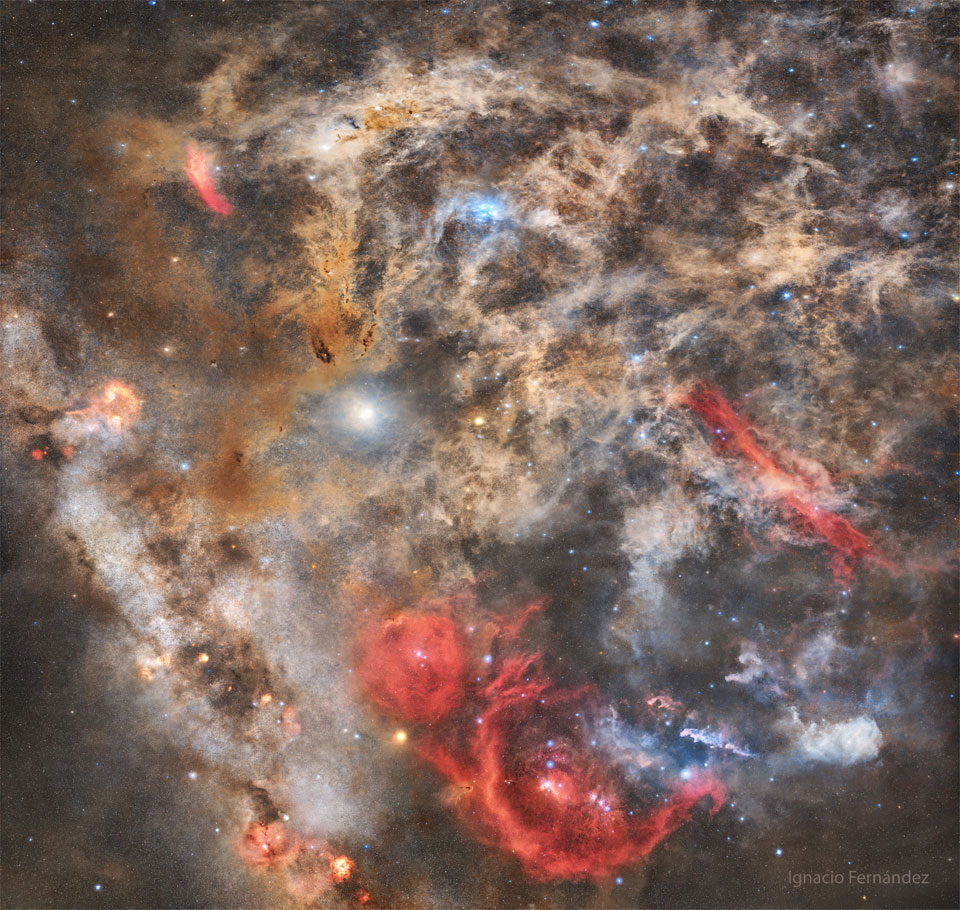
Unveiling the Cosmic Tapestry: Orion's Hidden Neighborhood Revealed

📖 3 min read 📊 beginner 🏷️ NASA APOD

In Brief

A breathtaking new image, built from 16 hours of observations, reveals the intricate, normally invisible network of dust and gas connecting famous celestial landmarks like the Orion Nebula and the Pleiades. It challenges our everyday view of the night sky, showcasing a hidden cosmic web that underlies the stars we know.
Unveiling the Cosmic Tapestry: Orion's Hidden Neighborhood Revealed

Disclosure: This post contains affiliate links. As an Amazon Associate, I earn from qualifying purchases.

The Full Story

We all know the iconic constellations like Orion and the sparkling Pleiades star cluster. But what if we told you that these cosmic neighbors aren't just isolated islands of light? A stunning new deep-sky image, captured over 16 hours from dark skies in Spain, unveils a previously unseen dimension to our cosmic backyard: a vast, intricate network of faint dust and gas that weaves through and connects these familiar sights. This "cosmic tapestry" isn't empty space between stars. It's filled with immense clouds of interstellar dust and gas – the very raw materials from which new stars and planets are forged. These tendrils, like cosmic spiderwebs, link famous objects such as the glowing Orion Nebula (a stellar nursery), the sprawling Barnard's Loop, the mysterious Witch Head Nebula, and even the distant California Nebula. They are part of the Milky Way's intricate structure, forming the grand stage upon which cosmic events unfold. The challenge in spotting these celestial filaments lies in their subtlety. Unlike bright stars or nebulae that actively emit light, these dust clouds often just reflect a tiny fraction of starlight or glow faintly at wavelengths our eyes aren't sensitive to. It's like trying to see fine threads of smoke against a dark background – you need just the right lighting and a very long exposure to capture their delicate presence. Our usual perception of the night sky, even from dark locations, only captures the brightest cosmic beacons, missing the vast, dim infrastructure. To bring this hidden complexity to light, astronomers and astrophotographers employ a technique called deep-sky imaging. This involves collecting light over many hours, sometimes even nights, through highly sensitive cameras. The 16 hours of exposure time for this particular image allowed enough faint photons from the scattered dust and gas to accumulate, revealing structures that would otherwise remain completely invisible. It's a testament to how patience and specialized equipment can dramatically expand our view of the universe. This remarkable image forces us to reconsider our mental map of the night sky. The stars we cherish are just the brightest jewels in a much larger, more complex cosmic crown. Seeing these interconnected dusty structures helps scientists better understand the true distribution of matter in our galaxy, how star-forming regions are linked, and the dynamic interplay between stars and the material they are born from. It paints a more complete, breathtaking picture of the universe we inhabit.

Key Takeaways

  • 1 A new 16-hour exposure image reveals hidden networks of dust and gas around famous sky objects.
  • 2 These "cosmic filaments" connect celestial landmarks like Orion and the Pleiades.
  • 3 They represent the raw material for new stars and planets, showing the universe's underlying complexity.
  • 4 Long-exposure astrophotography is crucial for capturing these faint, normally invisible structures.
  • 5 This changes our understanding of galactic structure and star formation.
National Geographic Planisphere Star Finder

National Geographic Planisphere Star Finder

Essential tool for identifying constellations and stars. Perfect for beginners learning the night sky.

Check Price on Amazon
*As an Amazon Associate, we earn from qualifying purchases.

💡 Think of it this way:

Imagine looking at a familiar city skyline at night and only seeing the brightest buildings. This new image is like suddenly seeing all the faint, glowing fog and unseen roadways connecting those buildings, revealing the true scale and intricate layout of the entire metropolitan area.

How We Know This

This stunning view wasn't captured in a single snapshot. It's a 'deep-sky composite' created by combining many hours – 16 hours in this case – of light collected by a specialized camera from a very dark-sky location in Granada, Spain. Think of it like leaving your camera shutter open for an incredibly long time to gather every faint whisper of light from these distant, dim clouds. Each tiny photon eventually builds up to reveal structures that are otherwise too faint for our eyes or even short exposures to detect.

What This Means

This kind of detailed imaging is vital for understanding the grand architecture of our Milky Way galaxy. By mapping these vast dust and gas networks, scientists can better track the flow of cosmic material, identify potential new star-forming regions, and piece together the evolutionary story of our galactic neighborhood. It helps us build a more accurate 3D model of the local universe and deepens our appreciation for the dynamic, interconnected nature of space.

Why It Matters

This discovery transforms how we see our universe, moving beyond isolated stars to reveal the vast, interconnected ecosystems where stars are born and galaxies evolve. It's a vivid reminder of the universe's profound hidden beauty and complexity, making us rethink what's 'out there' every time we look up.

Related Topics

#Astronomy #Nebulae #Star Formation #Astrophotography #Cosmic Dust