Back to Articles Image Of The Day

Galaxy Glow-Up: Webb and Hubble Reveal a Cosmic Dance of Dust and Stars

πŸ“– 3 min read πŸ“Š beginner 🏷️ NASA APOD

In Brief

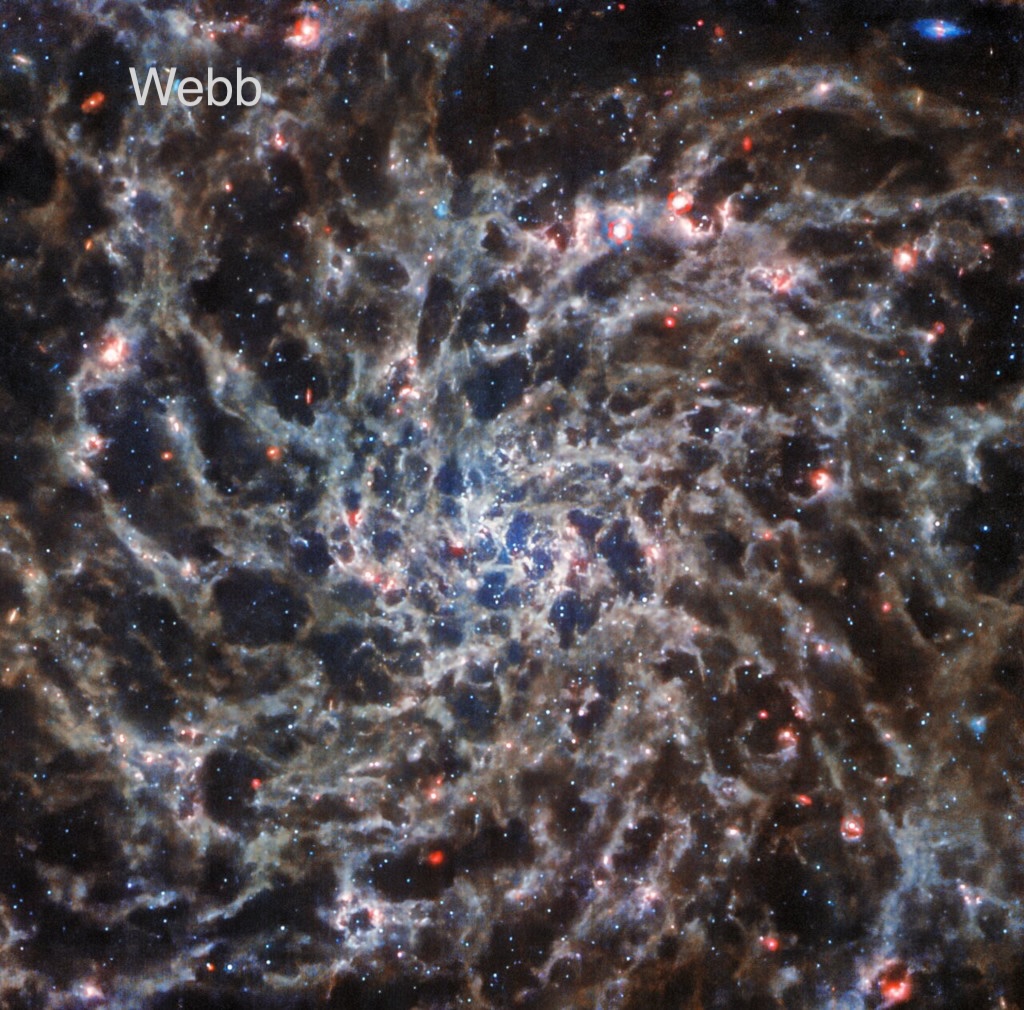
NASA's Webb and Hubble telescopes offer stunning, contrasting views of the spiral galaxy IC 5332. While Hubble shows dark dust lanes blocking visible light, Webb's infrared vision reveals these same dust clouds glowing brightly. This dual perspective helps scientists understand how galaxies are built from tiny dust particles to massive structures.
Galaxy Glow-Up: Webb and Hubble Reveal a Cosmic Dance of Dust and Stars

Disclosure: This post contains affiliate links. As an Amazon Associate, I earn from qualifying purchases.

The Full Story

Our universe is full of wonders, but our eyes can only perceive a tiny sliver of its light – what we call visible light. To truly grasp the secrets of distant galaxies, astronomers need to look beyond the rainbow. That's where two of NASA's most powerful space telescopes, Hubble and Webb, come in. They've teamed up to give us an extraordinary dual perspective of the spiral galaxy IC 5332, revealing aspects that would otherwise remain hidden. When Hubble looks at IC 5332, it primarily sees the galaxy in ultraviolet and visible light, much like our own eyes. In this view, the galaxy's beautiful spiral arms are clearly defined by bright stars, but you also notice vast, dark lanes snaking through them. These aren't empty spaces; they're giant clouds of interstellar dust. Just like a dense fog on Earth, this cosmic dust scatters and absorbs visible light from the stars behind it, creating dark silhouettes that block our view. Now, switch to Webb's perspective. It's like putting on a pair of infrared goggles that can see heat. When that same interstellar dust absorbs visible light, it warms up ever so slightly, and then re-emits that warmth as infrared light. Webb, with its incredible infrared vision, doesn't see these dust clouds as dark obstacles. Instead, it sees them glowing brightly, almost like cosmic embers, revealing a much finer, more intricate web of structures that were completely obscured in Hubble's view. To capture this delicate infrared glow, Webb's Mid-InfraRed Instrument (MIRI) needs to operate at an astonishingly cold temperature: a chilling -266ΒΊC (or -447ΒΊF). Why so cold? Because if the instrument itself were warmer, it would emit its own infrared radiation, overpowering the faint heat signals it's trying to detect from distant galaxies. It's a bit like trying to hear a whisper in a noisy room – you need absolute silence to pick up the faint sound. By combining these two distinct views – Hubble showing the stars and the dust as dark barriers, and Webb revealing the glowing heat of that very same dust – astronomers gain an unparalleled understanding of IC 5332. This complementary approach helps them connect the 'small scale' processes of gas and dust interacting with stars to the 'truly large scale' evolution and structure of an entire galaxy. It's like seeing both the skeleton and the muscle of a cosmic creature, giving us a far more complete picture of how galaxies live and breathe across the universe.

Key Takeaways

  • 1 Webb and Hubble provide contrasting views of spiral galaxy IC 5332, each revealing different aspects.
  • 2 Interstellar dust, which appears dark and opaque in visible light (Hubble), glows brightly in infrared light (Webb).
  • 3 This dual perspective helps astronomers understand the interplay between dust, gas, and stars, which is crucial for galaxy formation and evolution.
Hubble Space Telescope Deep Field Poster

Hubble Space Telescope Deep Field Poster

Stunning poster featuring iconic Hubble Space Telescope imagery. Perfect for space enthusiasts.

Check Price on Amazon
*As an Amazon Associate, we earn from qualifying purchases.

πŸ’‘ Think of it this way:

Imagine looking at a dusty room with your bare eyes – you see shadows. Now imagine putting on special glasses that make the dust itself glow with heat. That's essentially what Webb does for galaxies, letting us see through the cosmic 'smoke' that blocks visible light.

How We Know This

Astronomers used two powerful space telescopes, Hubble and Webb, as different 'eyes' to observe the same galaxy. Hubble captured the galaxy in ultraviolet and visible light, similar to what our eyes might see, showing stars and dark dust lanes. Webb, on the other hand, used its Mid-InfraRed Instrument (MIRI) to detect the heat glowing from cosmic dust. MIRI needs to be kept incredibly cold, at -266ΒΊC, to prevent its own warmth from interfering with the faint infrared signals it's trying to detect from space. By comparing these two different light 'snapshots,' scientists can piece together a more complete story of the galaxy.

What This Means

This combined view from Webb and Hubble provides an unprecedented look at the life cycle of galaxies. By understanding how dust, gas, and stars interact on a small scale, astronomers can build more accurate models of how entire galaxies form, grow, and change over billions of years. This allows us to trace the cosmic origins of elements and structures that eventually lead to planets and even life, pushing the boundaries of our understanding of the universe.

Why It Matters

This discovery helps us understand the fundamental building blocks of galaxies, including our own Milky Way. By seeing what's hidden from our normal sight, we get a clearer picture of how stars are born, how galaxies evolve, and ultimately, our place in the vast cosmos.

Related Topics

#Astronomy #Galaxies #Webb Telescope #Hubble Telescope #Infrared