Back to Articles Image Of The Day

Cosmic Shadow: Unmasking the Milky Way's Interstellar Ghost, Barnard 93

📖 3 min read 📊 beginner 🏷️ NASA APOD

In Brief

Meet Barnard 93, an eerie dark nebula floating within our Milky Way, resembling a ghostly inkblot against a tapestry of stars. Captured by astrophotographer Christian Bertincourt, this region of dense cosmic dust and gas blocks starlight, making it appear as a void.
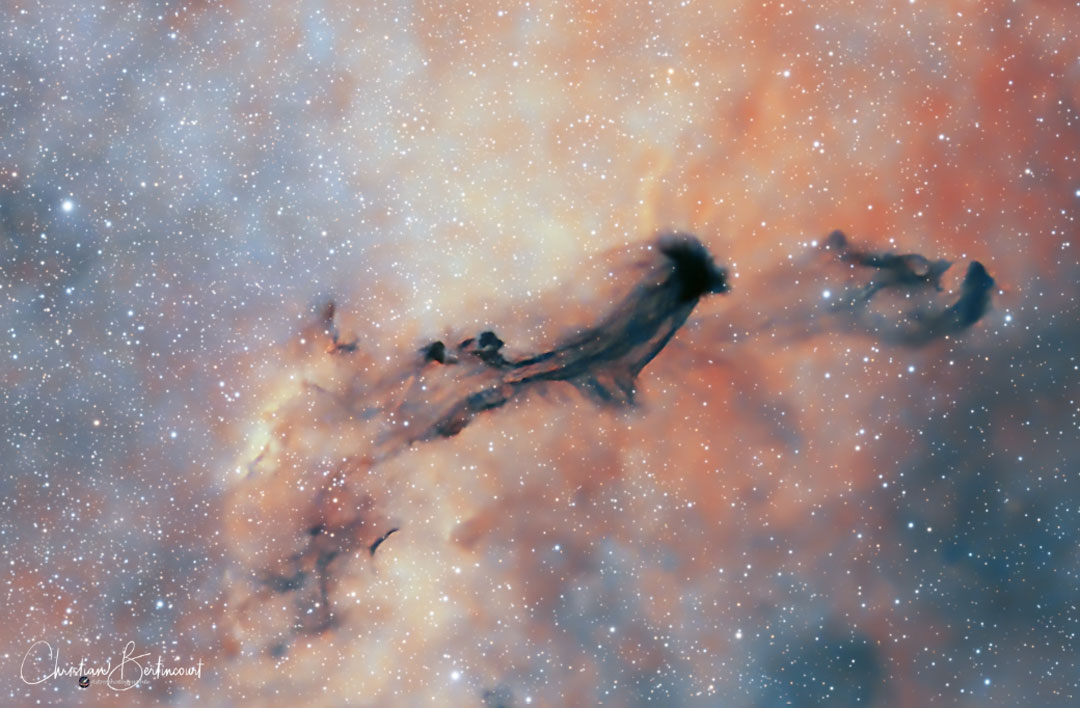
Cosmic Shadow: Unmasking the Milky Way's Interstellar Ghost, Barnard 93

Disclosure: This post contains affiliate links. As an Amazon Associate, I earn from qualifying purchases.

The Full Story

Floating silently within the star-dusted arm of our Milky Way galaxy, Barnard 93 (B93) presents itself as a striking silhouette against the glittering backdrop of the Small Sagittarius Star Cloud. Astrophotographer Christian Bertincourt aptly described it as “a ghost in the Milky Way,” a perfect metaphor for this celestial object that isn't truly empty space, but rather a dense congregation of cosmic dust and gas. Unlike bright nebulae that glow with the light of nearby stars, B93 absorbs and blocks light, making it appear as a mysterious void in the starry expanse. Barnard 93 is a type of object known as a dark nebula, which are immense clouds of interstellar matter so thick that they obscure the light from stars behind them. These aren't just empty holes; they are rich with hydrogen molecules, helium, and tiny dust grains – the very raw materials from which stars and planetary systems are forged. The darkness of B93 is a testament to its density, with countless microscopic particles acting like a cosmic curtain, preventing distant starlight from reaching our telescopes. These seemingly barren regions are, in fact, incredibly important cosmic real estate. Dark nebulae like B93 are considered stellar nurseries, the very wombs where new stars are born. Within their cold, dense cores, gravity slowly but surely pulls together clumps of gas and dust. Over immense spans of time, these clumps grow denser and hotter until, eventually, they ignite into brand-new stars. By studying these dark clouds, astronomers can gain crucial insights into the initial conditions and processes that lead to star formation, a fundamental process in the universe. B93 is listed as the 93rd entry in American astronomer E. E. Barnard's pioneering Catalogue of Dark Nebulae, compiled over a century ago. Its location within the Small Sagittarius Star Cloud (also known as Messier 24) is particularly fascinating. M24 itself isn't a true star cluster but rather a large gap in the Milky Way's interstellar dust clouds, offering us a rare, unobstructed view into a deeper, more densely populated part of our galaxy. Against this brighter, star-rich background, B93's profound darkness stands out even more dramatically, emphasizing its role as a cosmic curtain. Observing B93 isn't just about admiring its ghostly beauty; it's about peering into the early stages of cosmic evolution. Each dust grain and gas molecule within it holds clues to the lifecycle of matter in the universe, from its dispersal after ancient stellar explosions to its eventual re-assembly into new generations of stars and planets. This makes B93 a living laboratory for understanding the ongoing stellar drama that shapes our galaxy.

Key Takeaways

  • 1 Barnard 93 (B93) is a dark nebula, appearing as a 'ghostly' dark patch in the Milky Way.
  • 2 Dark nebulae are dense clouds of gas and dust that block starlight, not empty space.
  • 3 These clouds are crucial 'stellar nurseries' where new stars are born.
  • 4 B93 is located within the Small Sagittarius Star Cloud (Messier 24), a region offering a deep view into our galaxy.
National Geographic Planisphere Star Finder

National Geographic Planisphere Star Finder

Essential tool for identifying constellations and stars. Perfect for beginners learning the night sky.

Check Price on Amazon
*As an Amazon Associate, we earn from qualifying purchases.

💡 Think of it this way:

Imagine looking up at a bright, clear night sky, and suddenly noticing a large, perfectly black shadow cast directly onto the stars, as if a giant, invisible hand blocked a patch of starlight. That's similar to what Barnard 93 looks like: a cosmic shadow.

How We Know This

Discovering and studying dark nebulae like B93 involves a unique approach. Unlike bright objects that emit or reflect light, dark nebulae are 'seen' by their absence of light. Astrophotographers use powerful telescopes equipped with sensitive cameras to capture images of vast regions of the sky. When a dense cloud of dust and gas exists between the observer and distant stars, that region appears black or significantly darker against the illuminated background. By meticulously processing these images, astronomers can map out the shapes, sizes, and even densities of these cosmic shadows.

What This Means

Studying Barnard 93 and other dark nebulae is vital for piecing together the grand story of star formation and galactic evolution. By analyzing their composition and internal structure, scientists can better understand the precise conditions needed for stars to ignite. This knowledge can help us trace the lineage of stars in our own solar neighborhood and predict where future stars will form. Future observations, perhaps with infrared telescopes that can peer *through* some of the dust, could reveal protostars (stars in their infancy) hidden within B93, offering direct glimpses into the very moment of stellar birth.

Why It Matters

Understanding these dark 'ghosts' helps scientists uncover the secrets of how stars are born and how galaxies like our own Milky Way evolve from these vast, seemingly empty cosmic nurseries.

Related Topics

#Dark Nebula #Star Formation #Milky Way #Astrophotography #Barnard 93