Back to Articles Image Of The Day

Comet Wierzchoś: A One-Way Ticket Out of Our Solar System

📖 3 min read 📊 beginner 🏷️ NASA APOD

In Brief

Meet Comet C/2024 E1 (Wierzchoś), a rare celestial visitor currently making its way through the inner Solar System. Unlike most comets that orbit our Sun, this one is on a unique, one-way journey. Its trajectory indicates it's traveling too fast to be captured by the Sun's gravity, meaning it will soon depart our Solar System forever, never to return.
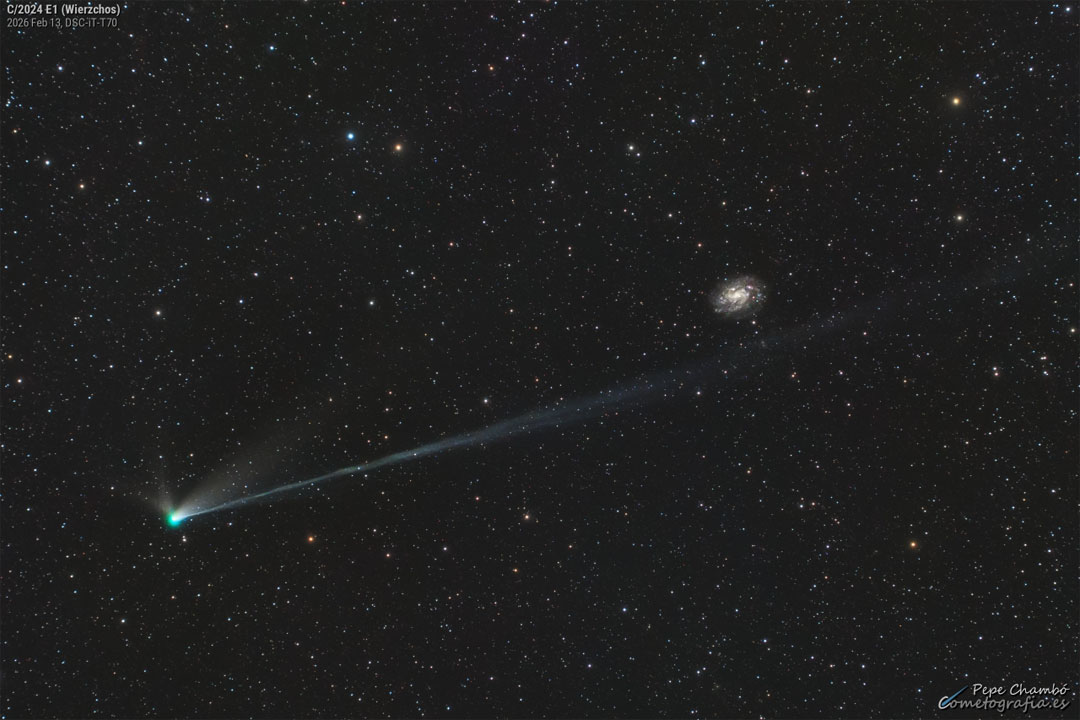
Comet Wierzchoś: A One-Way Ticket Out of Our Solar System

Disclosure: This post contains affiliate links. As an Amazon Associate, I earn from qualifying purchases.

The Full Story

Our cosmic neighborhood often hosts many celestial travelers, from familiar planets to comets that make regular, predictable loops around our Sun. But every now and then, a truly special guest arrives, like Comet C/2024 E1, named Wierzchoś after its discoverer. This icy visitor is currently shining brightly as it navigates the inner Solar System, offering astronomers and sky-watchers a rare spectacle. What makes Comet Wierzchoś so unique isn't just its current visibility, but its ultimate destiny. Most comets, those 'dirty snowballs' of ice and dust, follow elliptical orbits – think of them like a cosmic racetrack that brings them back to our inner Solar System periodically. Halley's Comet, for example, returns every 76 years. But Comet Wierzchoś isn't on such a loop; it's on a hyperbolic orbit. To understand a hyperbolic orbit, imagine throwing a ball straight up into the air. If you don't throw it hard enough, it will eventually fall back down due to Earth's gravity. But if you throw it with incredible speed – what we call 'escape velocity' – it will leave Earth's gravity entirely and never return. Comet Wierzchoś is doing just that with respect to our Sun. It’s traveling with such immense speed that the Sun's gravitational pull isn't strong enough to keep it captive, sending it on a path that curves once around the Sun and then straight out into the vastness of interstellar space. This one-way trip offers an extraordinary opportunity for scientists. Comets are essentially time capsules from the early Solar System, preserving pristine material from billions of years ago. By studying Comet Wierzchoś as it passes, astronomers can analyze its composition, tail structure, and behavior. This helps us understand what conditions were like at the Solar System's distant edges, possibly within the enigmatic Oort Cloud – a vast, icy sphere believed to surround our Sun far beyond Pluto – or even what materials exist in the space between star systems. While we might not get another chance to see Comet Wierzchoś once it leaves, its fleeting visit provides invaluable data. Each observation contributes to our understanding of how our Solar System formed and evolved, and how such objects are distributed throughout the cosmos. It's a poignant reminder of the dynamic, ever-changing nature of the universe, and a chance to bid farewell to a truly exceptional cosmic traveler.

Key Takeaways

  • 1 Comet Wierzchoś is a rare, one-time visitor to our Solar System.
  • 2 It's on a 'hyperbolic orbit,' meaning it will escape the Sun's gravity and leave forever.
  • 3 Observing it provides unique insights into the early Solar System's composition.
  • 4 It helps us understand objects from the distant Oort Cloud or potentially interstellar space.
Celestron NexStar 130SLT Computerized Telescope

Celestron NexStar 130SLT Computerized Telescope

Computerized telescope perfect for beginners. Features a 130mm aperture and automated tracking to explore the night sky.

Check Price on Amazon
*As an Amazon Associate, we earn from qualifying purchases.

💡 Think of it this way:

Imagine a distant relative who visits your town for the very first time, passes through, waves goodbye, and then continues their journey across the country, never taking the same route back. That's Comet Wierzchoś – a one-time visitor on an irreversible path.

How We Know This

Astronomers use powerful telescopes to track the comet's position and speed over time. By carefully mapping its trajectory, they can calculate its precise orbital path. If the comet's speed exceeds the 'escape velocity' for the Sun's gravity, scientists know it's on a hyperbolic path, destined to leave our Solar System rather than continuing to orbit within it.

What This Means

The study of comets like Wierzchoś helps scientists refine models of solar system dynamics and the distribution of matter in the outer Solar System. It's crucial for distinguishing between objects that originated within our own Solar System and true interstellar visitors, like 'Oumuamua. Data from these escaping comets also enhances our understanding of the primordial building blocks that formed planets, offering a deeper glimpse into our cosmic origins and the potential diversity of objects traversing the Milky Way.

Why It Matters

This is a fleeting opportunity to glimpse a true cosmic wanderer that likely hails from the very edge of our Solar System or even beyond. Studying such 'escapee' comets offers invaluable clues about the early formation of our Solar System and the mysterious icy frontiers of interstellar space.

Related Topics

#Comet #Solar System #Astronomy #Space Exploration #Oort Cloud