Back to Articles Image Of The Day

Dead Star's Shocking Secret: A Cosmic Mystery Unfolds

📖 4 min read 📊 beginner 🏷️ NASA APOD

In Brief

Astronomers are puzzled by a distant 'dead' star, known as a white dwarf, that is inexplicably creating powerful shock waves in space. This star, RXJ0528+2838, found 730 light-years away, is behaving in an unexpected way for a stellar remnant, challenging what we understand about the life and death of stars.
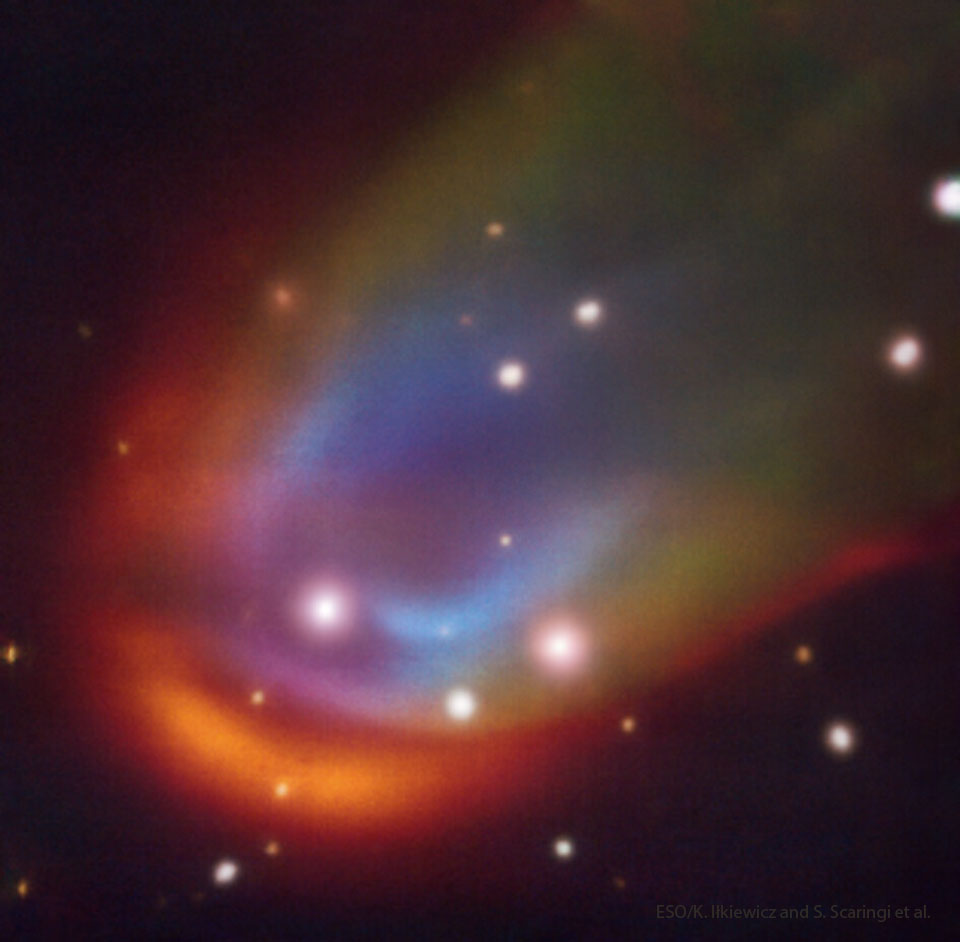
Dead Star's Shocking Secret: A Cosmic Mystery Unfolds

Disclosure: This post contains affiliate links. As an Amazon Associate, I earn from qualifying purchases.

The Full Story

Deep in the cosmic tapestry, about 730 light-years from Earth, lies a celestial object that's baffling astronomers: a white dwarf star named RXJ0528+2838. White dwarfs are essentially the leftover cores of stars like our Sun after they've exhausted their nuclear fuel. Picture our Sun in billions of years: it will swell into a red giant, shed its outer layers, and then its incredibly dense core will remain, slowly cooling over eons. These stellar 'corpses' are typically quiet, slowly fading embers in the vastness of space. That's why the discovery around RXJ0528+2838 is so surprising. Instead of being a serene, slowly cooling sphere, this particular white dwarf is generating powerful and unexplained shock waves. Think of a shock wave as a cosmic 'sonic boom' – a sudden, dramatic disturbance that propagates through space, carrying energy and causing effects on surrounding gas and dust. For a white dwarf, which has no active nuclear fusion to power such activity, creating these energetic ripples is akin to finding a cold, still engine suddenly roaring to life and producing exhaust. Astronomers are now scratching their heads, trying to figure out the source of this unexpected activity. What could be powering these cosmic shock waves? Is it interacting with a hidden companion star, perhaps a tiny, unseen object orbiting very closely? Could it be a peculiar internal process within the white dwarf itself that we don't yet understand? Or perhaps it's a unique interaction with the surrounding interstellar gas and dust, causing these ripples to form in an unusual way? Each possibility opens up new avenues of cosmic exploration. This discovery isn't just a curious anomaly; it's profoundly significant for our understanding of stellar evolution – the life cycle of stars. Current models suggest that white dwarfs should be fairly quiescent. Finding one actively generating shock waves challenges these long-held theories and suggests there might be unknown processes or dynamics at play in the late stages of a star's life. It pushes the boundaries of our knowledge, urging scientists to reconsider what we thought we knew about how stars end their journeys and interact with their environments. So, how did we even spot this cosmic oddity? While the original content doesn't specify, such discoveries typically involve powerful telescopes observing in various wavelengths of light – perhaps X-rays, radio waves, or visible light – that reveal these energetic disturbances. Moving forward, astronomers will focus even more powerful instruments on RXJ0528+2838, gathering more data. They'll be looking for subtle clues, like patterns in the shock waves, hints of a companion star, or specific types of radiation that could indicate the underlying mechanism. The hope is that by meticulously studying this 'dead' star's shocking secret, we can unlock new chapters in the story of the universe.

Key Takeaways

  • 1 A white dwarf star, RXJ0528+2838, is inexplicably creating powerful shock waves.
  • 2 White dwarfs are usually quiet, 'dead' stellar remnants, making this activity a mystery.
  • 3 The discovery challenges current understanding of stellar evolution and white dwarf behavior.
  • 4 Scientists are investigating potential causes, like hidden companion stars or unknown internal processes.
  • 5 Future observations with advanced telescopes are crucial to unraveling this cosmic puzzle.
National Geographic Planisphere Star Finder

National Geographic Planisphere Star Finder

Essential tool for identifying constellations and stars. Perfect for beginners learning the night sky.

Check Price on Amazon
*As an Amazon Associate, we earn from qualifying purchases.

💡 Think of it this way:

Imagine a burnt-out campfire ember, long thought to be cold and still, suddenly sending out powerful ripples of heat and light into the air around it. It's a completely unexpected and puzzling phenomenon, just like these shock waves from a 'dead' star.

How We Know This

Astronomers detected the unusual shock waves around RXJ0528+2838 using advanced telescopes. While specific instruments aren't named, such discoveries often involve observing different types of light (like X-rays or radio waves) that reveal energetic phenomena not visible to the naked eye. This data allowed them to identify the white dwarf and its mysterious activity.

What This Means

This discovery could lead to a significant revision of our models for stellar evolution, particularly the late stages of a star's life. It might reveal entirely new physical processes occurring around white dwarfs, or even hint at previously unknown types of celestial interactions. Ultimately, understanding this active 'dead' star will expand our knowledge of how stars influence their surroundings long after their main lives have ended, potentially impacting how we view our own Sun's ultimate fate.

Why It Matters

This cosmic riddle helps us learn more about the diverse lives and eventual deaths of stars, including our own Sun's distant future. Uncovering how this 'dead' star is so active could reveal entirely new phenomena and physics at play in the universe.

Related Topics

#White Dwarf #Stellar Evolution #Astrophysics #Space Mystery #Shock Waves