The Sun's Fiery Face: A Year of Spots and Solar Surprises
In Brief
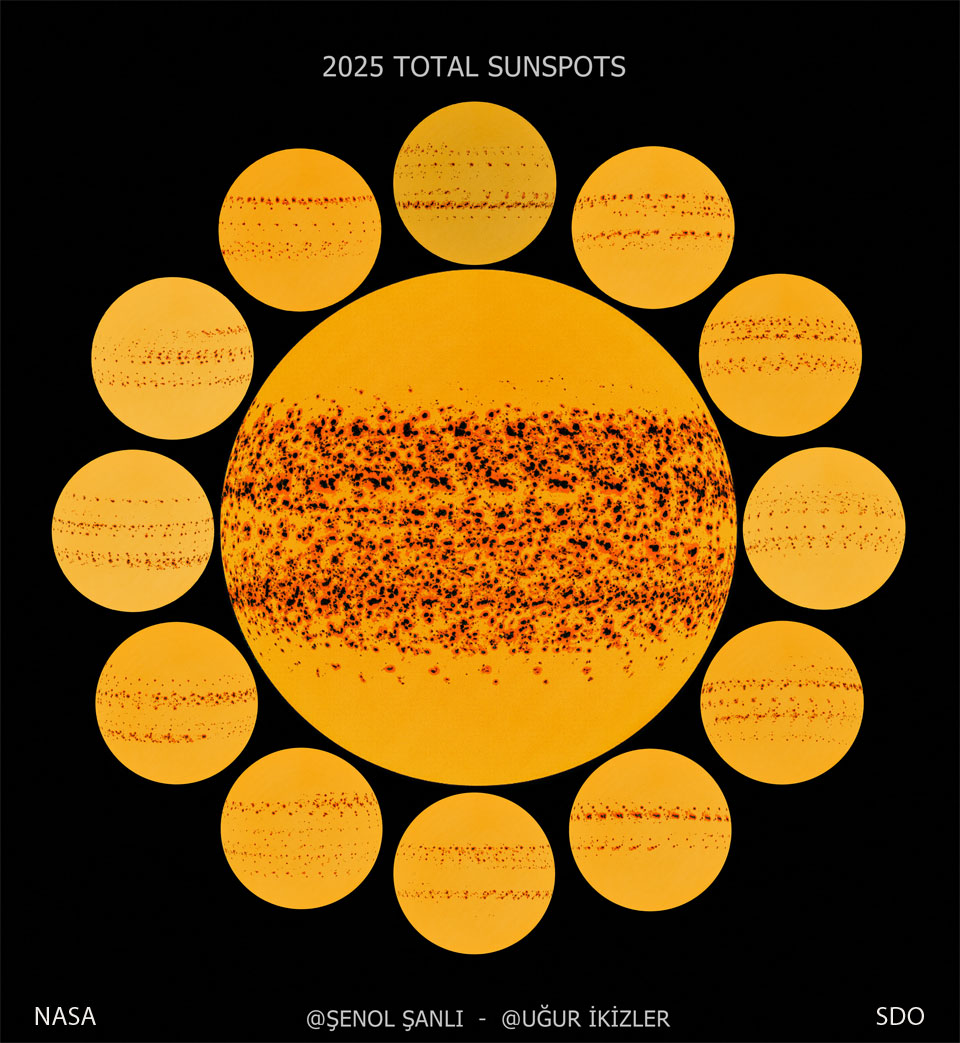
Imagine mapping every temporary 'freckle' on our Sun over a whole year – that's what this incredible visualization achieves for 2025! It showcases hundreds of sunspots that appeared month-by-month, culminating in a grand display of our star's active personality. Each dark spot is actually a magnetically-cooled region, offering a peek into the Sun's powerful inner workings.
The Full Story
Key Takeaways
- 1 Sunspots are dark, magnetically-cooled regions on the Sun's surface.
- 2 They are visual indicators of the Sun's powerful and constantly changing magnetic activity.
- 3 Sunspot activity directly influences space weather, affecting technology and communication on Earth.
💡 Think of it this way:
Think of sunspots like temporary, magnetic 'cold spots' or 'bruises' on the Sun's surface. They're like little windows showing where the Sun's intense magnetic fields are tangling and bubbling up, momentarily cooling that specific area.
How We Know This
Astronomers use specialized solar telescopes, both on Earth and in space, to constantly monitor our Sun in various wavelengths of light. By carefully tracking and imaging these dark regions day after day, month after month, they can compile a comprehensive 'map' of the Sun's ever-changing face, like this 2025 collection. Advanced imaging techniques then allow scientists to combine these observations into powerful visualizations that reveal long-term patterns.
What This Means
By continuously observing and analyzing sunspot patterns, scientists can refine their models of the Sun's magnetic behavior. This leads to more accurate predictions of solar flares and coronal mass ejections, which are often associated with sunspot activity. Better space weather forecasting allows us to prepare and protect vital infrastructure, from satellites and global communications to power grids, and ensures the safety of astronauts traveling beyond Earth's protective atmosphere. It also deepens our fundamental understanding of star physics, helping us understand other stars beyond our own.
Why It Matters
Understanding sunspots is crucial for us on Earth! They are indicators of the Sun's activity, which drives phenomena like solar flares and coronal mass ejections. These events can impact our technology, from satellite communication and GPS to power grids and astronaut safety.