Back to Articles Image Of The Day

Uranus's Bizarre Moon: A Fresh Look at Miranda's Unique Landscape

πŸ“– 3 min read πŸ“Š beginner 🏷️ NASA APOD

In Brief

Scientists have just released stunning new views of Miranda, one of Uranus's moons, by expertly combining old images from NASA's Voyager 2 mission. These updated pictures reveal a bizarre world unlike any other, covered in craters, fractures, and mysterious grooves.
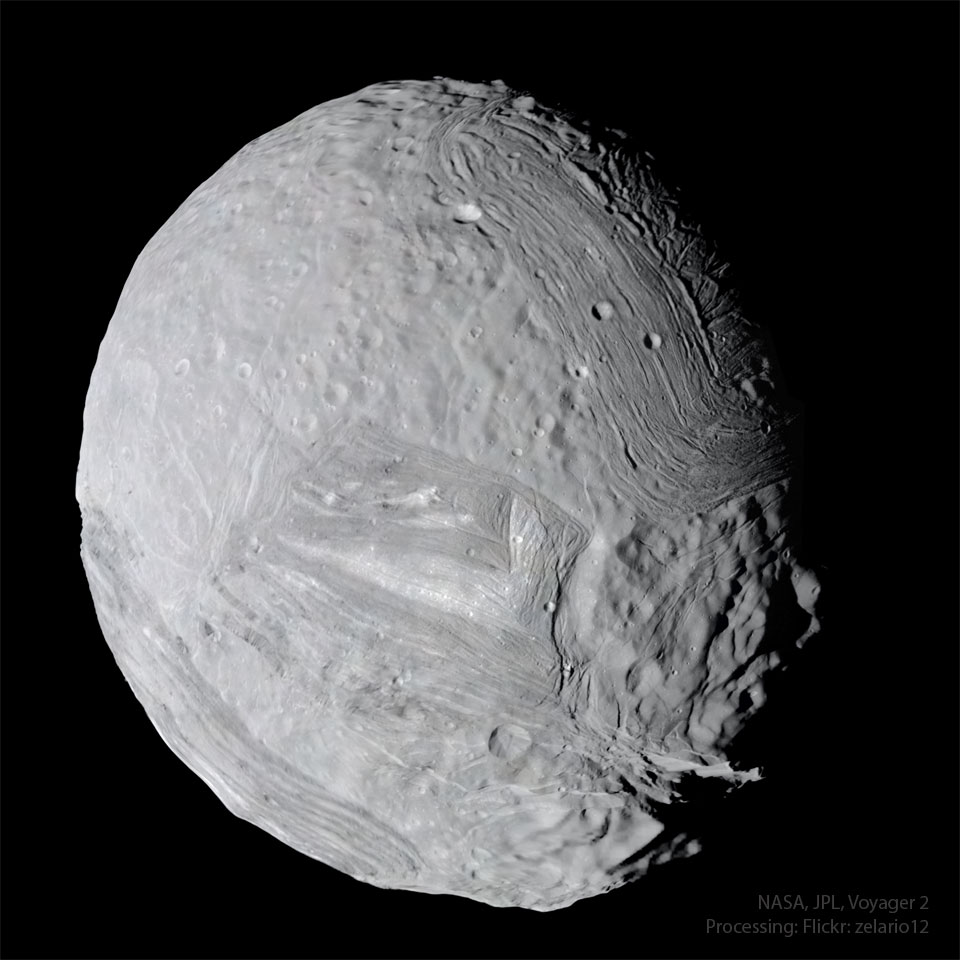
Uranus's Bizarre Moon: A Fresh Look at Miranda's Unique Landscape

Disclosure: This post contains affiliate links. As an Amazon Associate, I earn from qualifying purchases.

The Full Story

What is Miranda really like? For decades, our best answer came from a fleeting glance by NASA's Voyager 2 spacecraft in the late 1980s. Now, a fresh perspective on this intriguing moon of Uranus has emerged. Scientists have taken those vintage images, some of the only close-up views we have, and painstakingly combined and remastered them using modern digital techniques. The result is a breathtaking new portrait that brings Miranda's strange, fractured beauty into sharper focus than ever before. Miranda, a relatively small moon measuring only about 500 kilometers (310 miles) across, stands out in our solar system as a true geological enigma. Its surface is a jumbled patchwork of dramatically different terrains: ancient, heavily cratered regions sit right next to vast, smoother areas crisscrossed by deep grooves and towering cliffs. It looks as if someone took a celestial body, broke it into pieces, and then haphazardly glued it back together, making it a 'Frankenstein' moon of sorts. These dramatic features – particularly the massive 'racetrack' grooves and fractured canyons – are incredibly unusual for such a small, icy world, which scientists would typically expect to be geologically quiet. The original images were captured during Voyager 2's historic flyby of Uranus in January 1986. This was a challenging encounter, as the spacecraft zoomed past the distant gas giant and its moons, gathering data in a relatively short window. Voyager 2 provided our first (and so far, only) close-up look at Uranus and its system, including Miranda. The spacecraft had to make a swift pass, gathering as much visual information as possible under difficult lighting conditions and from various angles, which means the raw data wasn't always perfectly aligned or consistently lit. The recent remastering effort is a testament to the enduring value of old space data. Think of it like a digital restoration of an old, treasured photograph. Scientists carefully selected individual frames, corrected for distortions caused by the spacecraft's camera and motion, and used advanced software to stitch these disparate pieces together into a cohesive, high-resolution mosaic. They then enhanced the colors, sharpened the details, and balanced the lighting to reveal features that might have been less obvious in the original, separate images. This meticulous process provides a more complete and visually stunning map of Miranda’s northern hemisphere, allowing us to 'revisit' this unique moon with fresh eyes. This updated view of Miranda isn't just pretty pictures; it’s a crucial tool for planetary scientists. The moon's bizarre geology poses fundamental questions: How did it acquire such a patchwork appearance? Was it shattered by a massive impact and reassembled? Or did powerful internal forces, perhaps linked to tidal heating from Uranus, cause its crust to fracture and reshape dramatically? By getting a clearer look at the relationships between its different terrains, scientists hope to unravel the complex history of this tiny, yet incredibly dynamic, world. Miranda serves as a key example of extreme geological processes that can occur on icy moons in the outer solar system, teaching us about the incredible diversity of planetary evolution. While there are no immediate plans for a new mission to Uranus and its moons, these remastered images keep the scientific interest alive and provide a solid foundation for future studies. They help scientists refine models of moon formation and evolution, guiding what kinds of instruments and observations would be most valuable on a potential return mission. Understanding Miranda could offer broader insights into the conditions in the early solar system, the behavior of ice-rich planetary bodies, and perhaps even the potential for subsurface oceans or other dynamic activity hidden beneath the surfaces of other distant moons. It reminds us that even decades-old data can still yield exciting new discoveries with the right technological tools and a fresh perspective.

Key Takeaways

  • 1 Scientists have created stunning new views of Uranus's moon Miranda by digitally combining and remastering old images from NASA's Voyager 2 mission.
  • 2 Miranda is a small, 500-kilometer-wide moon known for its incredibly bizarre and patchwork surface, featuring deep grooves, towering cliffs, and heavily cratered regions.
  • 3 The moon's unique geology, which looks like it was smashed and reassembled, poses scientific questions about its violent past and how internal forces shape icy worlds.
  • 4 This effort highlights the ongoing value of historical space data and provides critical insights for understanding moon formation and evolution in the outer solar system.
Hubble Space Telescope Deep Field Poster

Hubble Space Telescope Deep Field Poster

Stunning poster featuring iconic Hubble Space Telescope imagery. Perfect for space enthusiasts.

Check Price on Amazon
*As an Amazon Associate, we earn from qualifying purchases.

πŸ’‘ Think of it this way:

Imagine taking several old, faded photos of a mysterious puzzle piece, then carefully stitching them together and enhancing them to finally see its true, strange shape – that's what scientists have done for Miranda, revealing a world that looks like it was pieced together from different geological terrains.

How We Know This

Scientists meticulously selected and combined multiple individual images taken by NASA's Voyager 2 spacecraft during its brief flyby of Uranus in the late 1980s. Using modern digital processing techniques, they carefully corrected for optical distortions, enhanced fine details, and stitched these separate images together to create a single, much clearer and more comprehensive visual map of Miranda's surface than was previously available.

What This Means

These enhanced views of Miranda help scientists refine models of how small, icy moons form and evolve, especially those in the frigid outer solar system. It offers a unique case study for understanding extreme geological processes, potentially guiding future missions to Uranus and its moons to seek answers about their mysterious origins and the potential for subsurface oceans or other dynamic activity.

Why It Matters

Understanding Miranda helps us piece together the dramatic stories of how moons form and change in the distant reaches of our solar system, offering clues to the universe's incredible diversity and the forces that shape planetary bodies.

Related Topics

#Uranus #Miranda #Voyager 2 #Planetary Science #Space Exploration