Catching a Glimpse of Saturn's Ocean Moon, Enceladus
In Brief
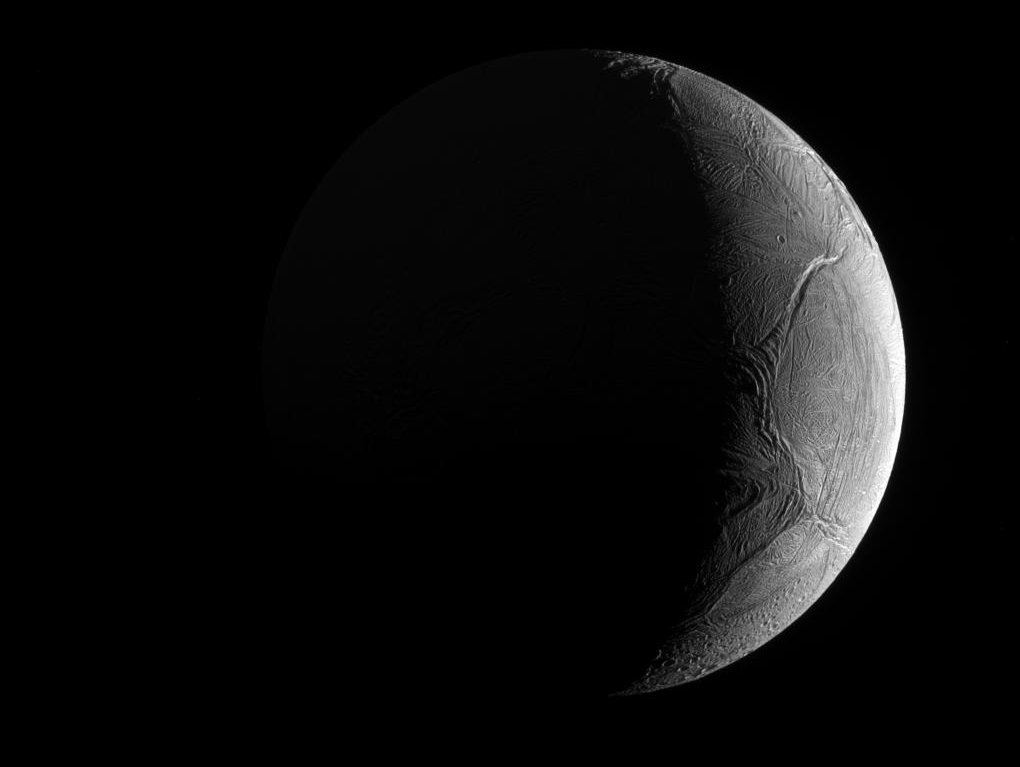
NASA's Cassini spacecraft captured a stunning crescent view of Enceladus, one of Saturn's most intriguing moons, from a unique sunward angle in 2016. This dramatic image shows its Saturn-facing side partly bathed in sunlight, revealing its icy, enigmatic surface.
The Full Story
💡 Think of it this way:
Imagine trying to get a perfect picture of a friend who's mostly in shadow, with just a sliver of sunlight catching their face – that's sort of what Cassini did, but with an entire moon 130,000 kilometers away!
How We Know This
NASA's Cassini spacecraft, which orbited Saturn from 2004 to 2017, was equipped with powerful cameras capable of capturing stunning images across various wavelengths of light. For this particular shot, Cassini's imaging team carefully maneuvered the spacecraft to look almost directly towards the Sun, with Enceladus in front. This 'forward-scattering' geometry meant that most of the moon was in shadow, but the thin crescent edge, illuminated by sunlight skimming its surface, dramatically highlighted the terminator – the line separating day from night. This allowed for detailed views of the moon's surface features at extreme angles, offering a unique perspective from about 130,000 kilometers away.
What This Means
The continued study of images like 'Crescent Enceladus' helps scientists piece together the moon's geological history, the nature of its subsurface ocean, and the processes driving its active geysers. Crucially, Enceladus's active ocean and evidence of organic chemistry make it one of the most promising places in our solar system to search for microbial life. This discovery drives concepts for future dedicated missions, like 'Enceladus Orbilander' or 'LIFE' (Life Investigation For Enceladus), which aim to directly sample its plumes or even land on its surface, pushing the boundaries of astrobiology and our understanding of where life might exist beyond Earth.
Why It Matters
Enceladus is a prime candidate in our solar system for potentially hosting extraterrestrial life due to its subsurface ocean and active geysers. Studying its appearance and features helps scientists understand this fascinating world and the conditions for life beyond Earth.