Back to Articles Image Of The Day

Cosmic Fireworks: The Star Factory That Made Us

πŸ“– 4 min read πŸ“Š beginner 🏷️ NASA APOD

In Brief

Cassiopeia A is the fiery remains of a giant star that exploded, scattering vital elements across the galaxy. This incredible event recycled stellar material, paving the way for new stars, planets, and even the building blocks of life itself.
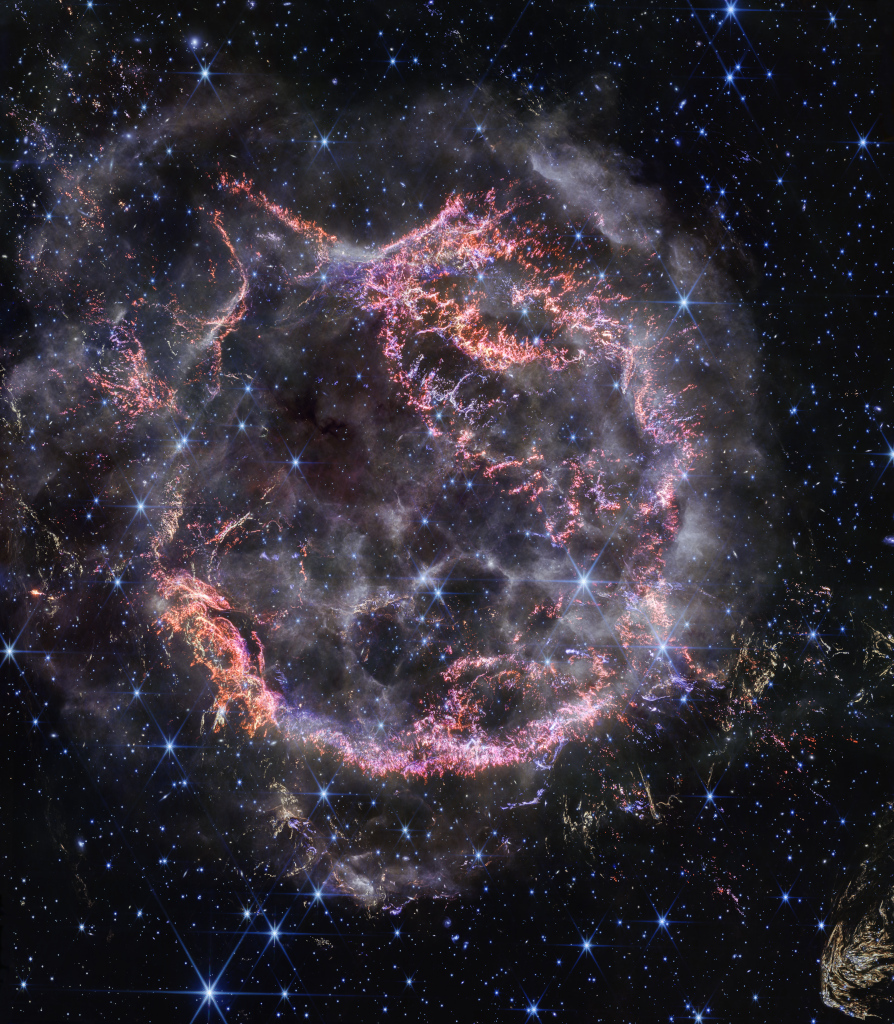
Cosmic Fireworks: The Star Factory That Made Us

Disclosure: This post contains affiliate links. As an Amazon Associate, I earn from qualifying purchases.

The Full Story

Deep within our Milky Way galaxy, stars live lives of epic proportions. When we look at something like Cassiopeia A, we're witnessing the dramatic aftermath of one such giant. This beautiful, glowing cloud is what's left behind after a truly massive star, many times larger than our Sun, reached the end of its spectacular life. For millions of years, these colossal stars act as natural cosmic furnaces. Driven by immense gravity, they ignite nuclear fusion in their cores, mashing lighter elements like hydrogen and helium together to forge heavier ones. Think of it as a celestial alchemist's workshop, gradually creating carbon, oxygen, nitrogen, and eventually even iron. These are the fundamental building blocks of everything we know, from rocks and water to plants and animals. But this stellar alchemy can't last forever. Once the star's core fills with iron, it can no longer generate energy through fusion. Without this outward pressure, gravity wins the battle, causing the star's core to collapse in less than a second. This catastrophic implosion then rebounds with unimaginable force, tearing the star apart in a dazzling explosion known as a supernova – one of the most powerful events in the universe. This explosion itself is so energetic that it creates even heavier elements, like gold, silver, and uranium, before blasting everything outwards into interstellar space. Cassiopeia A is the stunning supernova remnant from such an explosion, which astronomers believe happened around 340 years ago as seen from Earth. It's an expanding bubble of superheated gas and dust, still glowing brightly across the spectrum, a constant reminder of the star that once was. Studying remnants like this allows us to see how these newly forged elements are scattered far and wide, enriching the cosmic environment. This scattering of elements is not just a pretty show; it's absolutely vital for cosmic evolution. These enriched clouds of gas and dust eventually collapse under their own gravity to form new generations of stars and planets. Without these 'recycled' heavy elements, rocky planets like Earth, capable of supporting life as we know it, simply couldn't exist. In essence, the death of one star provided the raw materials for future worlds and future life.

Key Takeaways

  • 1 Massive stars are cosmic factories that create heavy elements through nuclear fusion.
  • 2 When these stars die in a supernova explosion, they blast these elements into space.
  • 3 Cassiopeia A is a prime example of a supernova remnant, showcasing this element distribution.
  • 4 These scattered elements are the essential building blocks for new stars, planets, and ultimately, life itself.
National Geographic Planisphere Star Finder

National Geographic Planisphere Star Finder

Essential tool for identifying constellations and stars. Perfect for beginners learning the night sky.

Check Price on Amazon
*As an Amazon Associate, we earn from qualifying purchases.

πŸ’‘ Think of it this way:

Imagine a massive star as a gigantic cosmic oven, baking new ingredients (elements) in its core. When it's done, it dramatically bursts open like a piΓ±ata, showering the universe with these precious ingredients, ready for new recipes (solar systems and life) to be made.

How We Know This

Scientists study supernova remnants like Cassiopeia A using powerful telescopes that can 'see' different types of light, or wavelengths. For example, X-ray telescopes (like NASA's Chandra X-ray Observatory) are crucial for mapping the extremely hot gas and newly formed elements within the remnant. Radio telescopes reveal the shockwaves and magnetic fields, while optical telescopes (like Hubble) show the expanding gas clouds. By combining data from these different 'eyes,' astronomers can piece together the complete story of the star's death and the journey of its ejected material.

What This Means

Understanding supernova remnants like Cassiopeia A is key to unlocking some of the universe's biggest mysteries. It helps us track the cosmic 'recipe' for new star and planet formation, understand how galaxies evolve, and even estimate the frequency of these life-giving explosions. By studying the elements distributed by these events, we gain deeper insights into the origins of our solar system and the potential for life to emerge elsewhere in the vast cosmos, reinforcing the idea that we are all, quite literally, stardust.

Why It Matters

The oxygen we breathe, the iron in our blood, and the silicon in our computers all owe their existence to such stellar explosions. This discovery highlights our deep cosmic connection to the lives and deaths of stars, showing us how the universe literally made us.

Related Topics

#Supernova #Cassiopeia A #Star Life Cycle #Heavy Elements #Cosmic Recycling