Peering into NGC 55: Finding Cosmic Clouds in a Neighboring Galaxy
In Brief
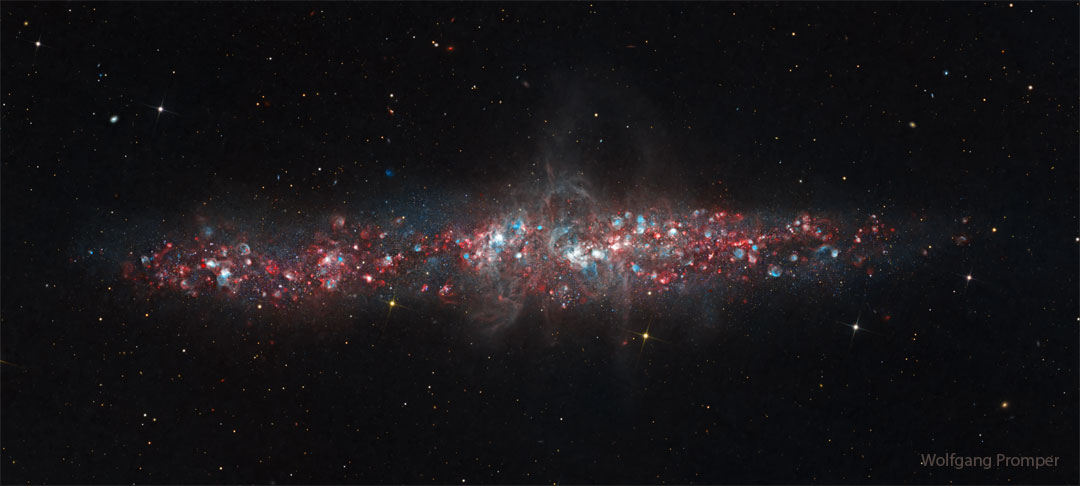
Astronomers have found a clever way to spot faint, glowing gas clouds – called nebulas – within galaxies far beyond our own Milky Way. By focusing on the specific colors of light emitted by hydrogen and oxygen, they can make these distant celestial nurseries visible. This breakthrough allows us to study star formation in other galaxies with unprecedented clarity.
The Full Story
Key Takeaways
- 1 Astronomers can now identify faint nebulas in distant galaxies like NGC 55.
- 2 This is achieved by isolating specific colors of light emitted by hydrogen and oxygen gas.
- 3 Observing these stellar nurseries in other galaxies provides crucial insights into star formation and galactic evolution.
💡 Think of it this way:
Imagine trying to find a specific colored light bulb in a house miles away. Normally you couldn't see it, but if you wore special glasses that only showed that exact color, suddenly it would pop out! That's similar to how astronomers 'filter' light to see nebulas in other galaxies.
How We Know This
Astronomers use specialized telescopes equipped with highly sensitive cameras and very narrow-band filters. These filters act like highly selective color screens, blocking out most light and only allowing specific wavelengths – the 'colors' – of light from hydrogen (often red) and oxygen (blue-green) to pass through. By capturing multiple images through these different filters and then combining them, they create a clear, high-contrast picture of the nebulae, revealing structures that would otherwise be hidden by the overwhelming brightness of the galaxy's stars.
What This Means
This groundbreaking technique opens up vast new opportunities for studying star formation across the cosmos. Future observations using this method will allow us to map star-forming regions in countless galaxies, helping us understand how gas clouds collapse to form stars in diverse galactic environments. This could reveal universal patterns in star birth or unique variations linked to galaxy type, deepening our knowledge of galaxy formation and evolution over billions of years and potentially giving us clues about the future of our own galaxy.
Why It Matters
This discovery helps us understand how stars are born across the universe, not just in our own cosmic neighborhood. By studying star formation in other galaxies, we gain crucial insights into how our own Milky Way galaxy formed and evolved, and how the universe came to be filled with stars and planets.