Mars' Moon Phobos: A Cosmic Clock is Ticking Down
In Brief
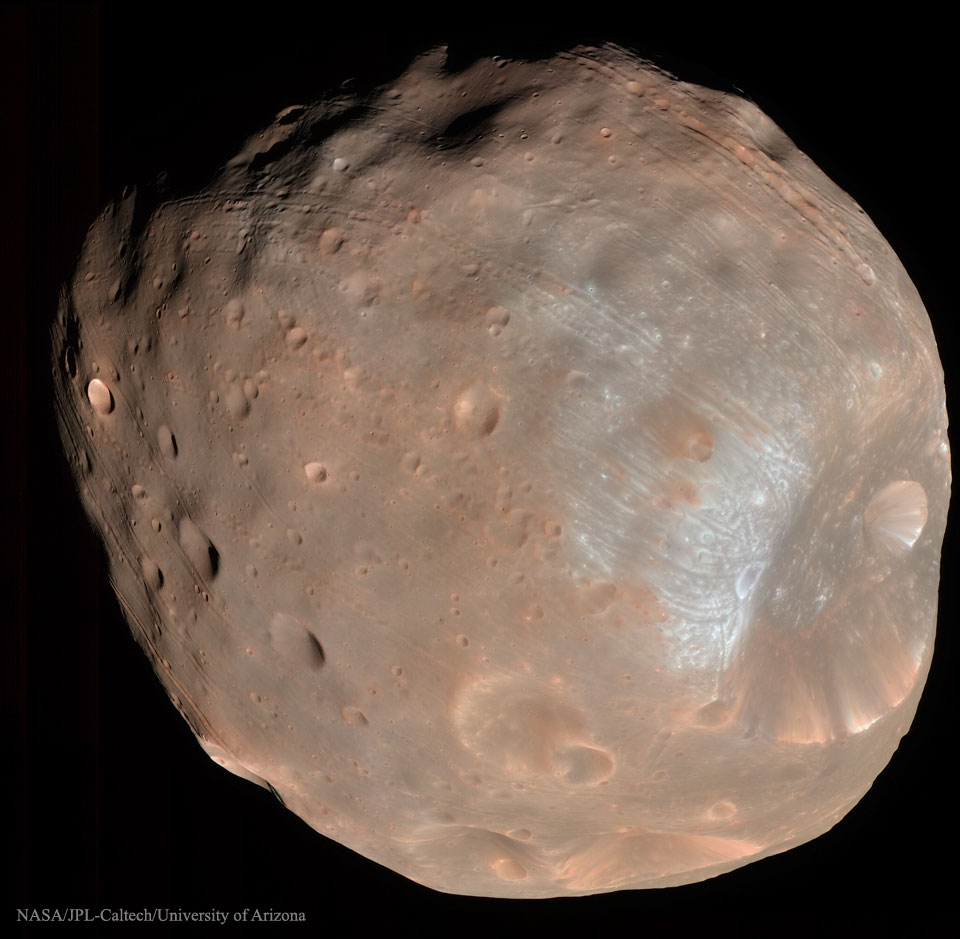
One of Mars' tiny moons, Phobos, is slowly but surely spiraling inward toward the Red Planet. Scientists predict it will eventually either crash into Mars or be torn apart by gravity, forming a temporary ring. This celestial drama gives us a live look at how moons evolve and planetary systems change over time.
The Full Story
Key Takeaways
- 1 Mars' moon Phobos is slowly spiraling inward toward the planet.
- 2 Scientists believe Phobos is a captured asteroid, not formed with Mars.
- 3 Phobos is destined to either crash into Mars or break apart to form a ring.
- 4 Its fate offers unique insights into planetary and moon evolution.
💡 Think of it this way:
Imagine a tiny toy car circling a much larger spinning top, but with an invisible string slowly pulling the car closer and closer. Eventually, the string will pull it too close, and the car will either crash into the top or break into pieces, scattering around it.
How We Know This
Scientists track Phobos' subtle inward drift by carefully observing its orbit using powerful telescopes and data from spacecraft like NASA's Mars Reconnaissance Orbiter. By analyzing the tiny changes in its path over decades, coupled with sophisticated computer models based on the laws of physics and gravity, they can accurately predict its long-term future. It's like using advanced GPS data and complex calculations to foresee where a very slow-moving object will be millions of years from now.
What This Means
The slow demise of Phobos offers a precious opportunity for scientists. It's a real-world case study of tidal forces in action, helping us understand how these powerful gravitational interactions influence planets and moons across the universe. By studying Phobos, we gain insights into the early solar system, the potential formation of planetary rings, and the long-term evolution of celestial bodies. Future robotic missions, and eventually human missions to Mars, might even consider studying Phobos up close before its final act, offering unprecedented data on its composition and the forces acting upon it.
Why It Matters
Understanding the fate of Phobos helps us unlock secrets about the formation and evolution of moons and planets throughout our solar system, including our own. It's a real-time lesson in the powerful gravitational forces that shape cosmic landscapes, reminding us that even our solar system is a dynamic, ever-changing place.