Cosmic Ghost Bubble: A Star's Last Breath Revealed
In Brief
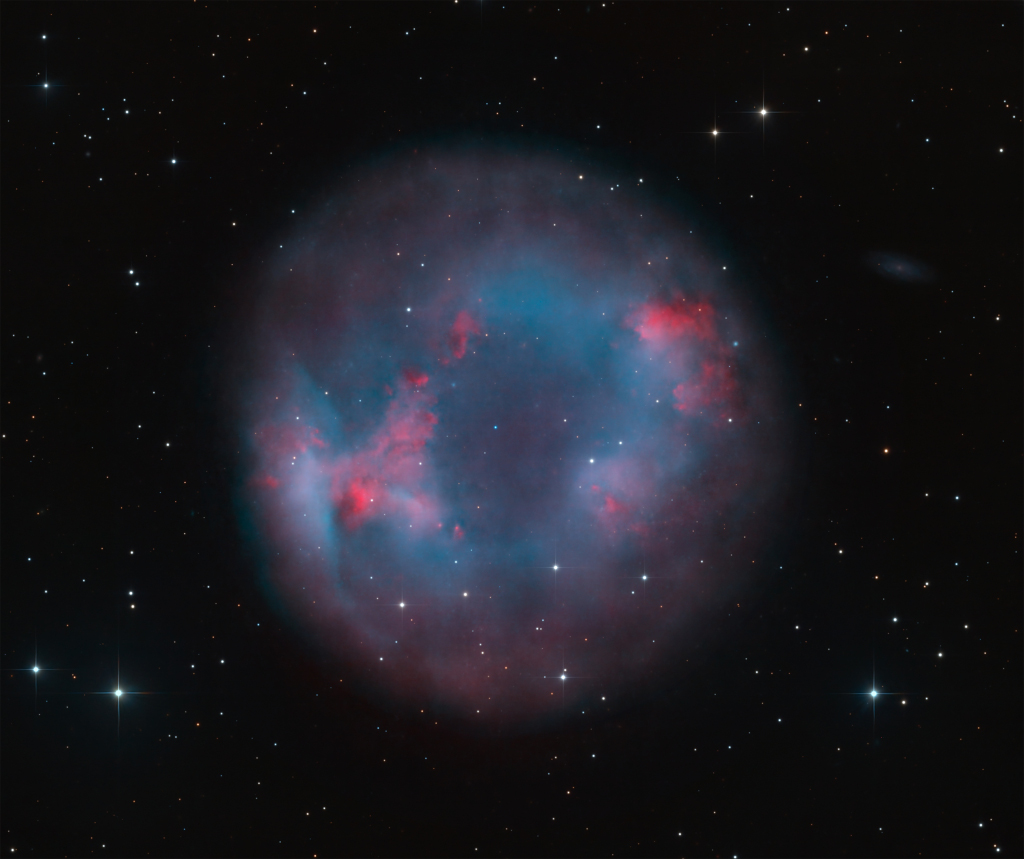
Astronomers have captured a stunning image of Abell 7, a vast, faint bubble of gas about 1,800 light-years away. This beautiful "planetary nebula" represents the final stage in the life of a dying star, much like our own Sun will experience billions of years from now.
The Full Story
Key Takeaways
- 1 Abell 7 is a 'planetary nebula,' a vast, glowing bubble of gas and dust from a dying star, about 1,800 light-years away.
- 2 It demonstrates the final stage in the life cycle of stars similar to our Sun, where outer layers are shed, forming a beautiful, spherical cloud.
- 3 Studying Abell 7 and similar objects helps scientists understand stellar evolution and how elements crucial for life are recycled in the universe.
💡 Think of it this way:
Imagine a giant soap bubble or a delicate smoke ring expanding slowly in space, glowing with the remnants of a dying star at its center. That's essentially what a planetary nebula like Abell 7 looks like, but on a cosmic scale.
How We Know This
The stunning image of Abell 7 was captured using 'deep imaging' techniques. This involves powerful telescopes acting like giant light buckets, collecting faint photons from distant objects over many hours of exposure time. By accumulating light over such long periods, astronomers can reveal the intricate structures and delicate glow of nebulae like Abell 7, which would otherwise be too dim to see.
What This Means
Observing and studying planetary nebulae like Abell 7 is crucial for refining our models of stellar evolution and understanding the ultimate fate of stars, including our own Sun. These observations provide direct evidence for how stars enrich the cosmos with heavier elements – the building blocks for future stars, planets, and even life itself. Continued study will help us better predict when and how new stars and planetary systems will form from these cosmic remnants.
Why It Matters
It offers a beautiful glimpse into the dramatic end-of-life cycle for stars like our Sun, reminding us of the cosmic processes that shape the universe and eventually our own solar system's fate. It connects us to the grand cycle of stellar life and death.