Back to Articles Image Of The Day

Webb Telescope Unveils Cosmic Giant: The Barred Spiral Galaxy NGC 1365

πŸ“– 4 min read πŸ“Š beginner 🏷️ NASA APOD

In Brief

The James Webb Space Telescope has captured a breathtaking new image of NGC 1365, an enormous barred spiral galaxy located 56 million light-years away. This cosmic behemoth, twice the size of our Milky Way, is seen in stunning detail thanks to Webb's ability to peer through cosmic dust with infrared light. Scientists are using this view to better understand how stars form and how galaxies evolve.
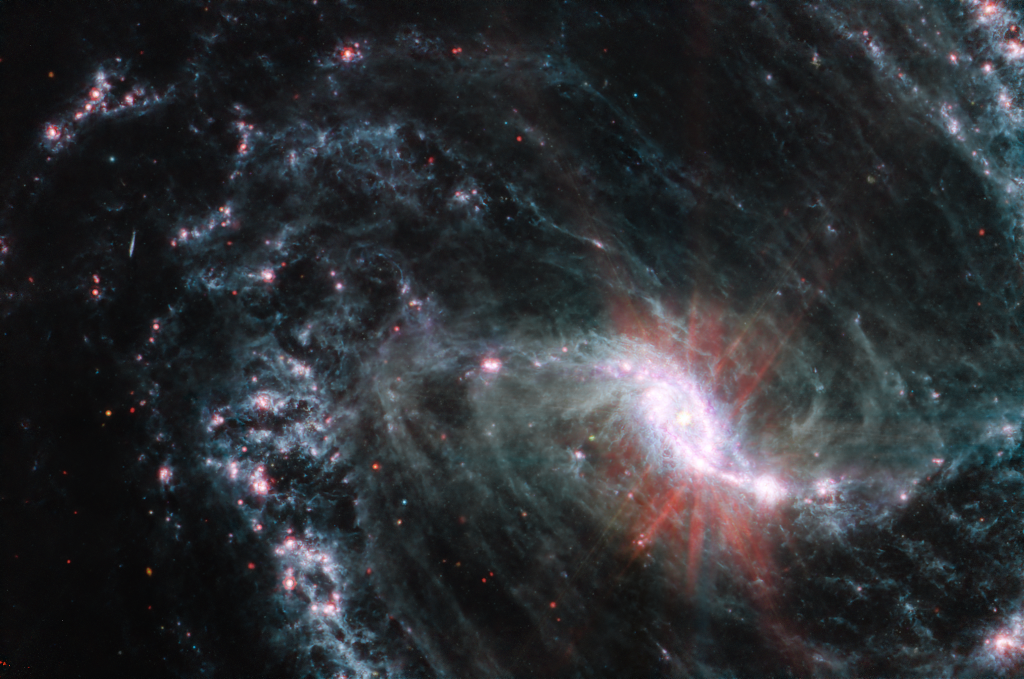
Webb Telescope Unveils Cosmic Giant: The Barred Spiral Galaxy NGC 1365

Disclosure: This post contains affiliate links. As an Amazon Associate, I earn from qualifying purchases.

The Full Story

From a cosmic distance of 56 million light-years, the James Webb Space Telescope (JWST) has given us an unparalleled close-up of the magnificent barred spiral galaxy NGC 1365. Tucked away in the southern constellation Fornax, this colossal galaxy spans an incredible 200,000 light-years across – making it twice the diameter of our very own Milky Way galaxy. Its distinctive 'barred' shape, with a prominent straight bar of stars and gas cutting through its center before the spiral arms begin, is a common feature in the universe, including our own galaxy. What makes this image truly special is that it was captured by Webb's Mid-Infrared Instrument (MIRI). Infrared light is like a superpower for astronomers, allowing them to see through thick clouds of cosmic dust that would otherwise block our view in visible light. Think of it as looking through smoke with special heat-vision goggles; Webb can detect the faint warmth emitted by dust and gas, revealing hidden structures and brand-new stars that are just beginning to glow. The MIRI observations of NGC 1365 reveal incredible detail within its spiral arms and, critically, along its central bar. These regions are teeming with vibrant star formation, where vast nurseries of gas and dust collapse under their own gravity to ignite new generations of stars. The 'bar' in barred spiral galaxies isn't just a pretty feature; it plays a crucial role in galaxy evolution, acting as a cosmic conveyor belt that channels gas and dust inward towards the galactic core, potentially feeding the supermassive black hole lurking there and triggering bursts of star formation. By studying NGC 1365 with such clarity, astronomers can learn more about how these galactic bars influence star birth and the overall development of galaxies. This giant galaxy serves as an excellent laboratory for understanding these fundamental processes because it's so active and relatively close. The intricate patterns of gas, dust, and young stars seen by Webb provide direct evidence of how matter is distributed and moves within such a massive system. Ultimately, images like this from Webb are more than just stunning pictures; they are vital pieces of a grand cosmic puzzle. Every detail helps scientists refine their models of galaxy formation and evolution, giving us deeper insights into how structures like the Milky Way came to be, how they change over billions of years, and what their ultimate fate might be. It’s like getting a detailed blueprint of a thriving cosmic city, helping us understand the one we live in.

Key Takeaways

  • 1 The James Webb Space Telescope has taken a detailed infrared image of NGC 1365, a barred spiral galaxy.
  • 2 NGC 1365 is a giant, twice the size of our Milky Way, located 56 million light-years away.
  • 3 Webb's Mid-Infrared Instrument (MIRI) allows us to see through cosmic dust to reveal hidden star formation.
  • 4 The galaxy's central 'bar' acts like a cosmic highway, funneling gas and dust to fuel new stars.
  • 5 Studying NGC 1365 helps astronomers understand how galaxies form, evolve, and give birth to stars.
Hubble Space Telescope Deep Field Poster

Hubble Space Telescope Deep Field Poster

Stunning poster featuring iconic Hubble Space Telescope imagery. Perfect for space enthusiasts.

Check Price on Amazon
*As an Amazon Associate, we earn from qualifying purchases.

πŸ’‘ Think of it this way:

Imagine a magnificent cosmic pinwheel twice the size of your hometown, where a bright, star-filled 'bar' acts like a superhighway in the middle, funneling gas and dust directly into the galaxy's center to fuel new star factories. That's a bit like NGC 1365, and Webb is like having a special set of glasses that lets us see through all the city's smog to watch the bustling activity inside!

How We Know This

The discovery was made using the James Webb Space Telescope (JWST), humanity's most powerful space observatory. Specifically, its Mid-Infrared Instrument (MIRI) captured the image. MIRI is designed to detect infrared light, which has longer wavelengths than visible light. This is crucial because infrared light can penetrate the thick clouds of dust that obscure star-forming regions and galactic cores, allowing scientists to see what's happening underneath, including newly forming stars and the distribution of warm dust and gas.

What This Means

The detailed observations of NGC 1365 from Webb will significantly advance our understanding of several key astronomical areas. They will help clarify the role of galactic 'bars' in funnelling gas and driving star formation, offering insights into how our own Milky Way's bar impacts its evolution. This data will also refine models of galaxy growth and the lifecycle of stars within active galactic environments. Future studies using this data could even provide clues about the interaction between galaxies and their central supermassive black holes, ultimately painting a clearer picture of the universe's grand cosmic dance.

Why It Matters

Studying distant galaxies like NGC 1365 helps us unravel the mysteries of our own Milky Way galaxy. By observing its active star-forming regions and unique 'bar' structure, we gain clues about how galaxies are built, how stars are born, and what the future might hold for our cosmic home.

Related Topics

#Galaxy #James Webb Space Telescope #Astronomy #Star Formation #Infrared