Webb Telescope Peels Back Jupiter's Cloud Layers!
In Brief
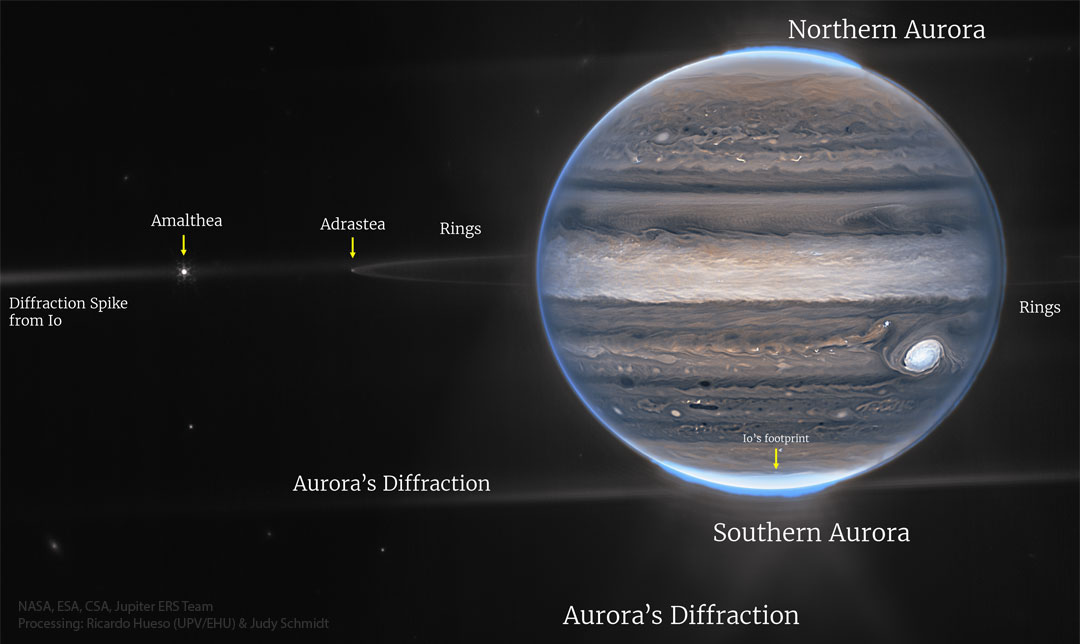
The James Webb Space Telescope (JWST) has delivered stunning new infrared images of Jupiter, offering unprecedented detail into its colossal atmosphere. These views clearly distinguish between high, bright clouds—like the iconic Great Red Spot—and the darker, lower cloud decks, revealing Jupiter's complex weather systems.
The Full Story
Key Takeaways
- 1 Webb's infrared vision reveals Jupiter's detailed cloud structure.
- 2 Scientists can now clearly differentiate between high, bright clouds (like the Great Red Spot) and low, dark clouds.
- 3 This helps unlock secrets about Jupiter's extreme weather, atmospheric dynamics, and energy transport.
- 4 The data from Jupiter aids in understanding gas giants across the universe, including exoplanets.
- 5 Webb's unique infrared capabilities provide unprecedented resolution and sensitivity for planetary observations.
💡 Think of it this way:
Imagine trying to understand how a layered cake is made just by looking at the frosting. Webb's infrared vision is like having special 'heat-vision' glasses that let you peer through the frosting to see the different cake layers, fillings, and even how they're stacked!
How We Know This
The James Webb Space Telescope (JWST) uses special cameras that detect infrared light, which is essentially heat energy. Unlike visible light, infrared can penetrate through some atmospheric haze, allowing Webb to 'see' different temperature layers and altitudes within Jupiter's clouds. By measuring these infrared signals, scientists can map where different types of clouds are located in Jupiter's atmosphere.
What This Means
These discoveries will lead to significantly improved atmospheric models for Jupiter, enhancing our understanding of its complex weather systems and internal processes. This knowledge will also serve as a crucial benchmark for studying distant gas giant exoplanets, helping scientists interpret their atmospheric compositions and dynamics, and ultimately providing insights into planetary formation and evolution across the cosmos.
Why It Matters
Understanding Jupiter's dynamic atmosphere helps scientists learn about extreme weather on gas giants, which can shed light on how our own Earth's weather works, and even how planets form across the universe.