Back to Articles Image Of The Day

Stunning Close-Up: Dive into the Majestic Whirlpool Galaxy!

πŸ“– 3 min read πŸ“Š beginner 🏷️ NASA APOD

In Brief

Astronomers have captured an incredibly detailed new image of the iconic Whirlpool Galaxy, showcasing its beautiful spiral arms like never before. This cosmic neighbor, just 30 million light-years away, is renowned for its stunning structure and makes for one of the most picturesque sights in the night sky.
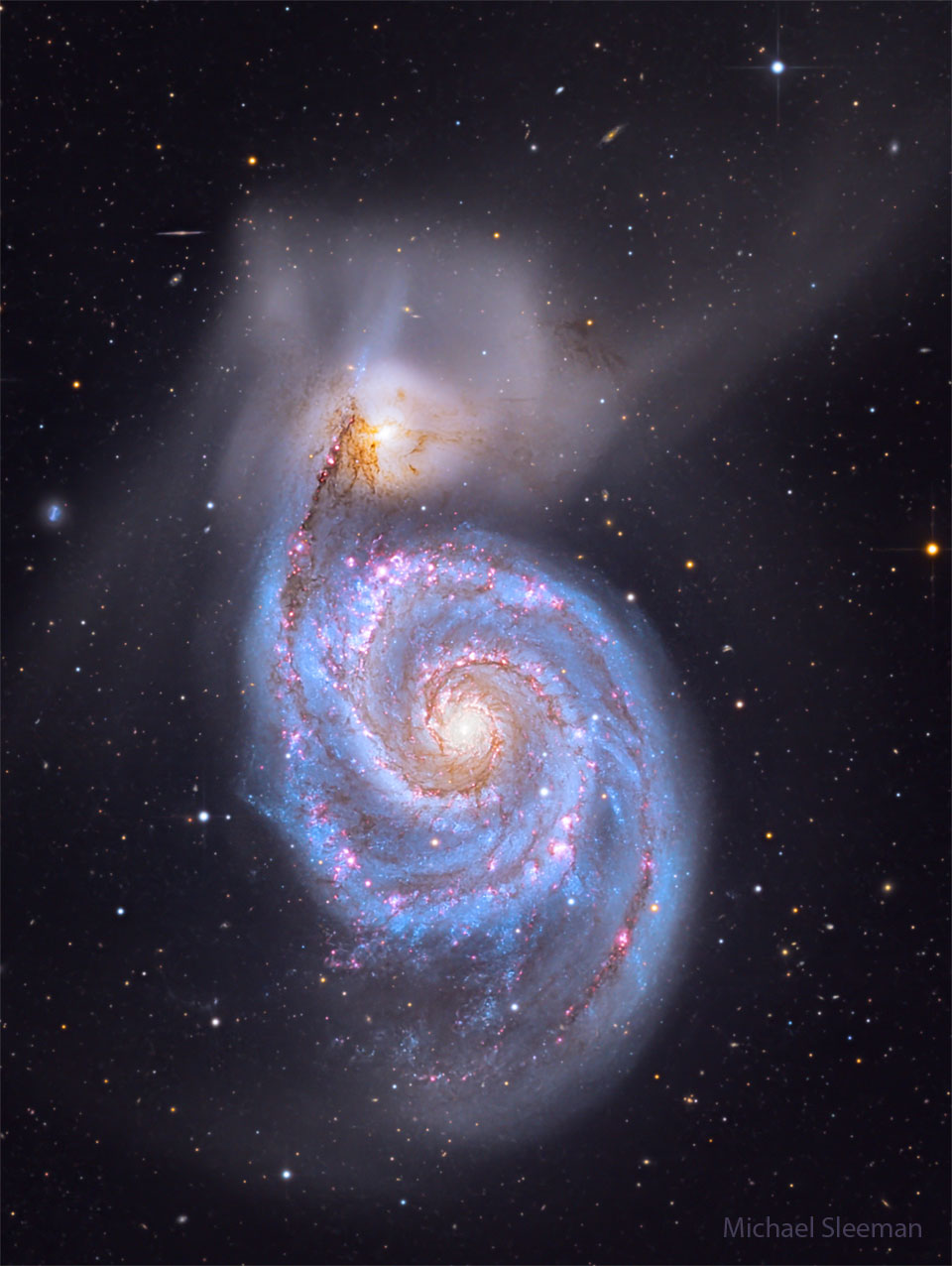
Stunning Close-Up: Dive into the Majestic Whirlpool Galaxy!

Disclosure: This post contains affiliate links. As an Amazon Associate, I earn from qualifying purchases.

The Full Story

Peering out into the cosmos, few sights captivate the imagination quite like the Whirlpool Galaxy, officially known as M51 or NGC 5194. This celestial wonder is the epitome of a 'classic' spiral galaxy, famous for its grand, sweeping arms that coil gracefully inwards towards its bright core. At a remarkable 60,000 light-years across, it’s a colossal city of stars, gas, and dust, and its stunning visual appeal has made it a favorite subject for both professional astronomers and amateur stargazers alike. What makes M51 truly special isn't just its beauty, but its relative 'closeness' to us. While 30 million light-years sounds incredibly far – meaning the light we see today left the galaxy 30 million years ago – it’s considered a galactic neighbor in the vast scale of the universe. This proximity allows astronomers to study its intricate details with exceptional clarity, revealing secrets that are simply too faint or too distant in other galaxies. Its impressive size, stretching 60,000 light-years, gives us a sense of the immense scale of these star-filled islands. The Whirlpool's picturesque nature isn't just a coincidence; it's profoundly influenced by a smaller companion galaxy, NGC 5195, tugging at its larger neighbor. This gravitational dance has likely played a significant role in shaping M51's prominent spiral arms, triggering waves of star formation that light up regions with brilliant young, blue stars and glowing nebulae. These interactions provide a dynamic laboratory for understanding how galaxies evolve, merge, and transform over cosmic timescales. By carefully studying galaxies like the Whirlpool, scientists gain crucial insights into the fundamental processes that govern our universe. How do spiral arms form and persist? What triggers bursts of star birth and death? What is the role of galactic interactions in the grand scheme of cosmic evolution? M51 serves as a magnificent natural experiment, helping us piece together the cosmic story that ultimately led to the formation of our own Milky Way and our solar system. The featured 'deep image' of the Whirlpool Galaxy pushes the boundaries of what we can see. This isn't just one single snapshot; it's a digital combination of many images taken over time, often through different filters and with powerful telescopes. By layering these exposures, astronomers can collect more light than any single picture, revealing incredibly faint details, subtle color variations, and structures that would otherwise remain hidden in the cosmic shadows. This advanced imaging technique allows us to truly immerse ourselves in the beauty and complexity of M51, offering a view almost as if we were there. This kind of detailed observation is crucial for ongoing research. Future telescopes, both on Earth and in space, will continue to explore M51 with even greater sensitivity and resolution. By monitoring star formation, mapping the movement of gas and dust, and modeling the gravitational interactions, scientists hope to further refine our understanding of galaxy dynamics. Each new image and data point from the Whirlpool Galaxy adds another piece to the puzzle of how the universe builds its grand structures, helping us contextualize our own cosmic home within this vast and magnificent tapestry.

Key Takeaways

  • 1 The Whirlpool Galaxy (M51) is a stunning spiral galaxy, relatively close at 30 million light-years away, making it a prime target for study.
  • 2 Its distinct spiral arms and vibrant star-forming regions are shaped by gravitational interaction with a smaller companion galaxy, making it a cosmic laboratory for galaxy evolution.
  • 3 New 'deep images' combine multiple observations to reveal unprecedented detail of M51's structure, allowing astronomers to explore its beauty and scientific secrets like never before.
Hubble Space Telescope Deep Field Poster

Hubble Space Telescope Deep Field Poster

Stunning poster featuring iconic Hubble Space Telescope imagery. Perfect for space enthusiasts.

Check Price on Amazon
*As an Amazon Associate, we earn from qualifying purchases.

πŸ’‘ Think of it this way:

Imagine looking at a distant, elegant dancer spinning gracefully, and this new image is like getting a front-row seat to see every intricate detail of their performance and how they interact with another dancer nearby.

How We Know This

The breathtaking view of the Whirlpool Galaxy is not from a single photograph, but rather a 'deep image' – a sophisticated digital composite. Imagine taking many pictures of the same scene, perhaps with different lighting or over an extended period. Astronomers do something similar, combining numerous exposures taken by powerful telescopes. By layering these digital images, they accumulate more light, making faint features pop out and revealing true colors and intricate details that would be invisible in a quick, single shot. This process is like stacking many short exposures to create one perfectly lit, highly detailed photograph, even in very dim conditions.

What This Means

Understanding the Whirlpool Galaxy provides crucial insights into the life cycle of galaxies themselves. It helps us decipher how stars are born and die, how massive black holes at galactic centers influence their surroundings, and especially, how gravitational forces drive the majestic evolution and interaction of these colossal star systems. This knowledge is directly applicable to our own Milky Way, giving us clues about its past formation, its ongoing interactions with neighboring galaxies, and its ultimate cosmic destiny.

Why It Matters

Gazing at the Whirlpool Galaxy helps us understand how galaxies, including our own Milky Way, form and evolve, offering clues to our place in the vast universe and the incredible forces at play.

Related Topics

#Whirlpool Galaxy #M51 #Spiral Galaxies #Astronomy #Galaxy Evolution