Back to Articles Image Of The Day

Sailing the Cosmos: How NASA's Tiny Craft Harnessed Sunlight

📖 4 min read 📊 beginner 🏷️ NASA APOD

In Brief

In 2011, NASA's NanoSail-D2 made history by unfurling a giant, ultra-thin sail to 'sail' through space using only sunlight. This groundbreaking mission proved that solar sailing, a concept once thought to be pure science fiction, is a real and viable way to travel without traditional rocket fuel.
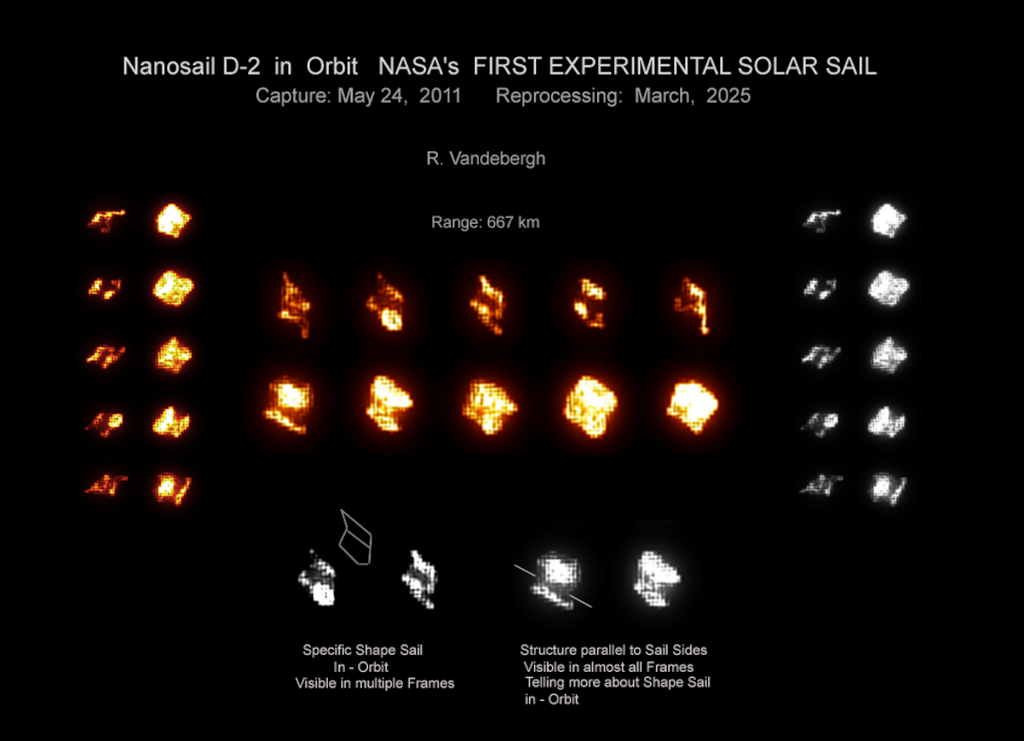
Sailing the Cosmos: How NASA's Tiny Craft Harnessed Sunlight

Disclosure: This post contains affiliate links. As an Amazon Associate, I earn from qualifying purchases.

The Full Story

In a remarkable feat of engineering and imagination, NASA's NanoSail-D2 spacecraft etched its name in history on January 20, 2011. This small, unassuming satellite, barely larger than a loaf of bread, deployed a massive, ultra-thin, and highly reflective sail measuring 10 square meters – roughly the size of a small bedroom. This wasn't just any deployment; it marked the first time a solar sail spacecraft successfully operated in low Earth orbit, proving that the futuristic concept of 'sailing' through space on beams of light was not only possible but a tangible reality. So, how does one 'sail' in the vacuum of space where there's no wind? The secret lies in sunlight itself. Light, while appearing massless, is actually made of tiny packets of energy called photons. When these photons from the Sun hit a highly reflective surface, they impart a tiny bit of their momentum, essentially giving the surface a gentle push. While each push is incredibly subtle, over time, and with a large enough sail, these continuous nudges can accelerate a spacecraft to astonishing speeds, much like a constant breeze gradually moves a sailboat. This ingenious idea dates back 400 years to astronomer Johannes Kepler, who observed comet tails always pointing away from the Sun and hypothesized that light might be exerting a force. NanoSail-D2 itself was a 'CubeSat' – a miniature, standardized satellite designed for low-cost missions and technology demonstrations. After being released from a larger spacecraft, it ingeniously unfurled its delicate, mirror-like sail from a compact package. This mission was purely experimental, designed to test the complex deployment mechanism and demonstrate the feasibility of solar propulsion. Its success proved that delicate structures could reliably unfold in space and that even the subtle pressure of sunlight could be harnessed to control and propel a spacecraft. Why is this significant? The biggest advantage of solar sailing is that it doesn't require traditional propellant. Rocket fuel is heavy and expensive, making up the bulk of a spacecraft's launch mass and dictating mission duration. By relying on an endless supply of sunlight, solar sails promise much lighter, cheaper spacecraft that can embark on longer missions, reaching distant corners of our solar system (or beyond) without the need to carry tons of fuel. This breakthrough dramatically reduces the barriers to deep-space exploration and opens up possibilities for entirely new types of missions. NanoSail-D2 paved the way for subsequent, more ambitious solar sail missions, such as The Planetary Society's LightSail 1 and 2, which further demonstrated controlled flight using sunlight. Looking ahead, solar sails could revolutionize space travel, enabling faster trips to Mars, creating 'solar observatories' that hover in fixed positions far from Earth, or even acting as a method to gently nudge space debris out of orbit. In the distant future, larger, more advanced solar sails could even be the key to interstellar travel, pushing humanity's reach far beyond our own solar system and into the vast unknown.

Key Takeaways

  • 1 NanoSail-D2 was the first solar sail spacecraft to operate in low Earth orbit in 2011.
  • 2 It demonstrated propulsion using only sunlight (photons) pushing against a large, reflective sail, eliminating the need for traditional rocket fuel.
  • 3 This mission validated a concept proposed 400 years ago by Johannes Kepler and opens new doors for lighter, cheaper, and longer space missions.
  • 4 It proved the technology for deploying delicate structures in space and harnessing solar pressure for propulsion.
NASA Mission Patches Collection Set

NASA Mission Patches Collection Set

Collection of iconic NASA mission patches. Great for space enthusiasts and collectors.

Check Price on Amazon
*As an Amazon Associate, we earn from qualifying purchases.

💡 Think of it this way:

Imagine pushing a sailboat with wind, but instead of wind, it's sunlight, and instead of water, it's the vacuum of space! Just as wind fills a boat's sail, tiny particles of light 'push' a solar sail.

How We Know This

NanoSail-D2 was a small satellite (a CubeSat) that was first launched into space in a compact form. Once in orbit, it used a specialized mechanism to autonomously unfurl its incredibly thin, highly reflective sail, much like a spring-loaded antenna but on a much larger scale. Ground control then monitored the spacecraft to observe how the sunlight subtly pushed against the sail, demonstrating controlled flight and orbital changes without any onboard fuel.

What This Means

The success of NanoSail-D2 has profound implications for the future of space exploration. It means spacecraft can be designed to be much lighter and thus cheaper to launch. Missions can also last much longer since they aren't limited by fuel reserves. This technology could enable new types of missions, such as sustained observation platforms far from Earth, faster interplanetary travel, or even as a method for 'space cleanup' by using solar pressure to deorbit old satellites and debris. It represents a significant step towards sustainable and more accessible space travel.

Why It Matters

This discovery offers a revolutionary, fuel-free way to explore space, making missions cheaper, lighter, and capable of traveling further and longer than ever before. It opens up new possibilities for understanding our solar system and beyond.

Related Topics

#Solar Sail #Space Exploration #NanoSail-D2 #NASA #CubeSat