Back to Articles Image Of The Day

The Crab Nebula: A Star's Explosive Secret Revealed

📖 3 min read 📊 beginner 🏷️ NASA APOD

In Brief

The beautiful Crab Nebula is the tangled aftermath of a star's dramatic explosion seen almost a thousand years ago. Scientists are puzzled by its glowing threads, which seem to have too little mass and are moving surprisingly fast, challenging our understanding of stellar death.
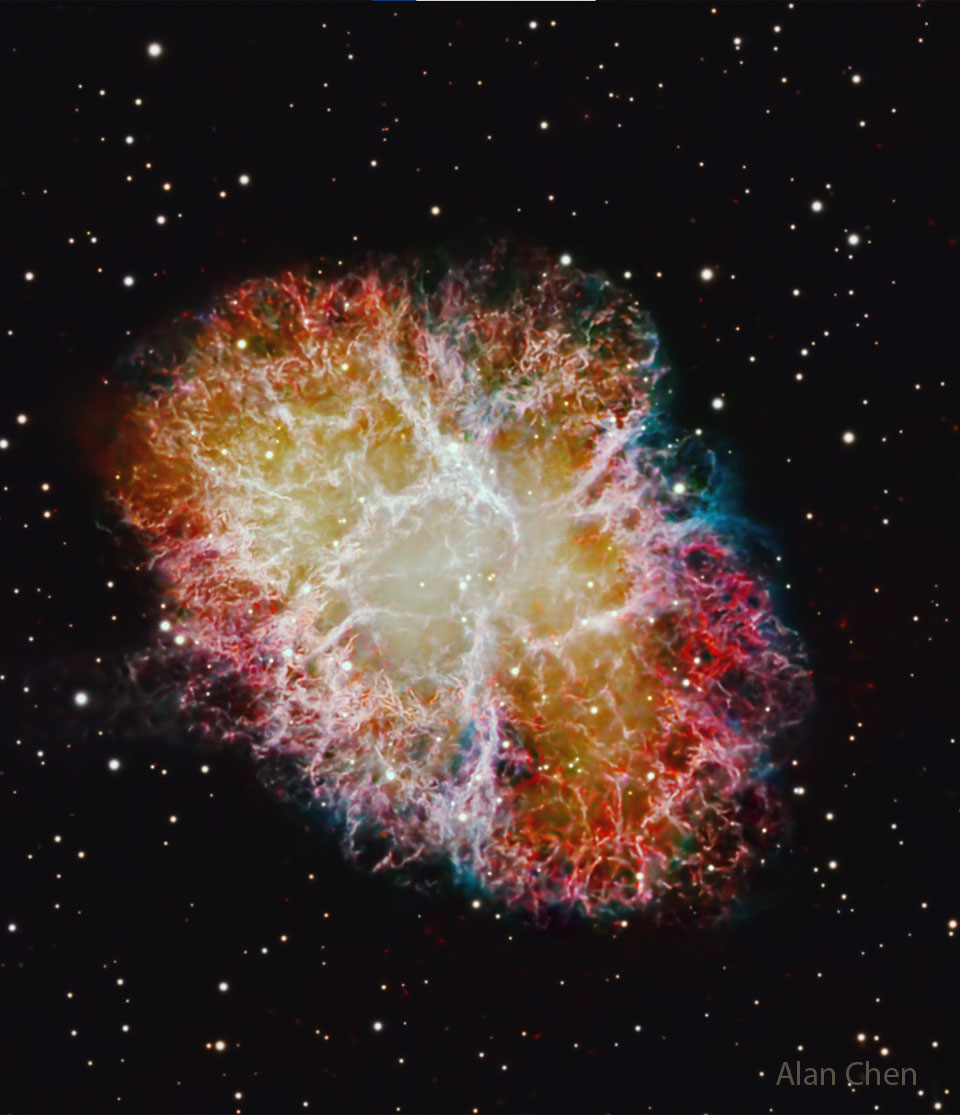
The Crab Nebula: A Star's Explosive Secret Revealed

Disclosure: This post contains affiliate links. As an Amazon Associate, I earn from qualifying purchases.

The Full Story

Peer into the vastness of space, and you’ll find wonders both beautiful and violent. One such spectacle is the Crab Nebula, a sprawling, glowing cloud located about 6,500 light-years away. This cosmic masterpiece is no serene nebula; it's the chaotic remnants of a massive star that dramatically ended its life in a colossal explosion, a supernova, witnessed and recorded by astronomers on Earth in 1054 AD. Today, the Crab Nebula dazzles us with its intricate network of fiery red and orange filaments – glowing threads of gas and dust. But beneath its stunning beauty lies a perplexing cosmic puzzle. Scientists have observed that these mesmerizing filaments appear to have less mass than what they expected was originally ejected during the supernova. Even stranger, these wisps are hurtling through space at speeds much higher than our current understanding of stellar explosions can easily explain. To grasp this mystery, let's briefly consider what happens when a star goes supernova. These are the spectacular death throes of stars many times more massive than our Sun. When such a star runs out of nuclear fuel, its core collapses, leading to an incredibly powerful explosion that blasts most of its outer layers, along with newly forged elements, into the surrounding space. Based on a star's initial size and the physics of such an event, we expect a certain amount of material to be flung out at a predictable speed. So, if our cosmic 'crime scene investigation' suggests a certain amount of stellar material should have been propelled into space at a specific velocity, why does the Crab Nebula show less mass moving significantly faster? This discrepancy challenges our very best models of supernova physics. It's like predicting how far a cannonball will travel and how much it weighs based on the cannon, only to find the actual cannonball is lighter and travels much further and faster than calculated. Solving the riddle of the Crab Nebula's mysterious filaments isn't just about understanding one beautiful cosmic object. It's about refining our fundamental understanding of how massive stars die, how the heavy elements that make up planets and life itself are forged and dispersed across the galaxy, and the extreme dynamics of the universe. Each clue we gather helps us piece together the grand cosmic story.

Key Takeaways

  • 1 The Crab Nebula is the remnant of a supernova observed in 1054 AD.
  • 2 Its glowing filaments pose a mystery: they have less mass and higher speeds than expected from current supernova models.
  • 3 This discrepancy challenges our fundamental understanding of how massive stars explode and distribute matter.
  • 4 Solving this puzzle is crucial for refining our knowledge of stellar evolution and the origin of elements.
Hubble Space Telescope Deep Field Poster

Hubble Space Telescope Deep Field Poster

Stunning poster featuring iconic Hubble Space Telescope imagery. Perfect for space enthusiasts.

Check Price on Amazon
*As an Amazon Associate, we earn from qualifying purchases.

💡 Think of it this way:

Imagine a giant balloon bursting, but instead of the pieces flying out exactly as expected, some parts are mysteriously lighter and zoom away much faster than they should, leaving scientists scratching their heads.

How We Know This

Astronomers use powerful telescopes, like the Hubble Space Telescope, to capture incredibly detailed images of nebulae like the Crab. By analyzing the light emitted by the glowing gases, they can determine the composition of the filaments. They also use the Doppler effect (how light shifts color based on movement) to measure the precise speeds at which these cosmic threads are expanding. Combining these observations with complex computer simulations helps them compare what they see to what their theories predict about supernova explosions.

What This Means

Future research will involve even more sophisticated observations and advanced computer simulations to explore new theories about supernova explosions. Perhaps there are unknown forces or processes at play, or our current models need significant tweaking to account for the Crab Nebula's peculiar properties. Unraveling this secret could lead to breakthroughs in astrophysics, giving us a clearer picture of the violent, yet ultimately life-giving, processes that shape our cosmos.

Why It Matters

Understanding this cosmic mystery helps us unravel how massive stars die, forge the elements essential for life (including those in our bodies!), and ultimately shape the universe we live in.

Related Topics

#Supernova #Crab Nebula #Stellar Remnants #Astrophysics #Cosmic Mysteries