Back to Articles Image Of The Day

Moon's Giant Shadows: A Majestic Sunrise on Lunar Mountains

📖 3 min read 📊 beginner 🏷️ NASA APOD

In Brief

During its first quarter phase, a specific time in the Moon's cycle, telescopes on Earth captured an incredible sight: the Sun rising along the Montes Caucasus mountains. This low-angle illumination created dramatically long, spire-like shadows stretching for miles across the lunar surface, offering a unique perspective on our celestial neighbor.
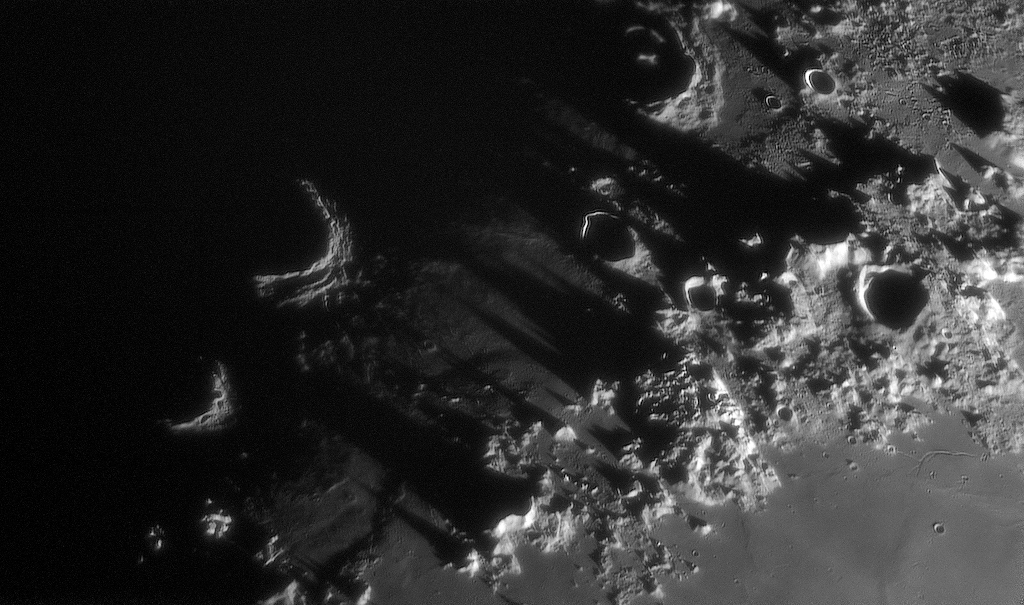
Moon's Giant Shadows: A Majestic Sunrise on Lunar Mountains

Disclosure: This post contains affiliate links. As an Amazon Associate, I earn from qualifying purchases.

The Full Story

Have you ever noticed how dramatic shadows look right after sunrise or before sunset? On Earth, these long, stretched-out shapes emphasize the height of objects. Now imagine this effect on the Moon, but with entire mountain ranges! That's exactly what astronomers observed recently, capturing a breathtaking image of the Montes Caucasus mountains casting magnificent, spire-like shadows as the Sun rose over them during the Moon's first quarter phase. This incredible view happens along what astronomers call the 'terminator' – the moving line that divides the sunlit part of the Moon from the dark, nighttime side. Think of it as the lunar dawn or dusk line. When the Moon is in its first quarter, we see half of its face lit up, and this terminator runs right through prominent features. The Montes Caucasus is one such prominent lunar mountain range, extending for hundreds of kilometers, and it becomes particularly striking when observed at this specific angle. Just like here on Earth, when the Sun is low in the sky, it casts incredibly long shadows. On the Moon, with no atmosphere to scatter light, these shadows are incredibly sharp and distinct. The length and shape of these lunar shadows are not just beautiful; they are incredibly informative. By studying them, scientists can actually determine the height of these lunar mountains and the ruggedness of the terrain, providing a '3D map' of the surface just from a 2D image. This phenomenon highlights that the Moon isn't a static, unchanging sphere. As it orbits Earth, different parts of its surface are illuminated at varying angles, revealing new details and textures with each lunar day. Observing the Moon during different phases, especially around the terminator, is like watching a slow-motion play of light and shadow, constantly showcasing different facets of its ancient, cratered, and mountainous landscape. These telescopic observations from Earth aren't just for awe; they contribute to our understanding of lunar geology and topography. Knowing the precise heights and ruggedness of these mountains is crucial for planning future lunar missions, including potential landing sites for human explorers and robotic probes. Every stunning image like this helps us map our nearest neighbor more accurately, paving the way for humanity's return to and deeper exploration of the Moon.

Key Takeaways

  • 1 Stunning long shadows reveal the dramatic topography of the Moon's Montes Caucasus mountains.
  • 2 The lunar terminator acts like a cosmic sunrise/sunset line, creating perfect conditions for observing these features.
  • 3 Studying the shadows helps scientists map mountain heights and understand lunar geology.
Celestron NexStar 130SLT Computerized Telescope

Celestron NexStar 130SLT Computerized Telescope

Computerized telescope perfect for beginners. Features a 130mm aperture and automated tracking to explore the night sky.

Check Price on Amazon
*As an Amazon Associate, we earn from qualifying purchases.

💡 Think of it this way:

Imagine a skyscraper or a tall mountain on Earth casting a shadow kilometers long just after dawn – this is essentially what we're seeing on a grand, cosmic scale, but on the Moon!

How We Know This

This captivating observation was made using powerful telescopes here on Earth. By carefully timing the observation to coincide with the Moon's first quarter phase, when the Sun's light hits the Montes Caucasus mountains at a very low angle along the terminator, astronomers were able to capture these dramatic shadows from millions of miles away.

What This Means

Understanding the Moon's precise topography and geological features through observations like this is vital for future lunar exploration. It informs decisions about safe landing sites for upcoming missions, helps identify areas of scientific interest, and deepens our appreciation for the Moon as a potential future outpost for humanity. Such detailed mapping supports the long-term goals of lunar resource utilization and establishing a sustainable human presence.

Why It Matters

This stunning view reminds us that the Moon is a dynamic world with breathtaking landscapes that constantly change with the lunar day. It helps us appreciate the beauty of lunar topography and how simple observations can reveal complex geological features, connecting us to the vastness of space from our own backyard.

Related Topics

#Moon #Lunar Geography #Astronomy #Telescopic Observation #Montes Caucasus