Back to Articles Image Of The Day

A Galactic Giant and a Fleeting Sky Spirit: Wonders Over Australia

📖 3 min read 📊 beginner 🏷️ NASA APOD

In Brief

An extraordinary photograph captures two wildly different phenomena: the ancient Andromeda galaxy, our galactic neighbor, and a mysterious, fleeting red sprite flashing high above Earth's stormy atmosphere. It's a breathtaking look at both the immense cosmic scale and the dynamic beauty of our home planet.
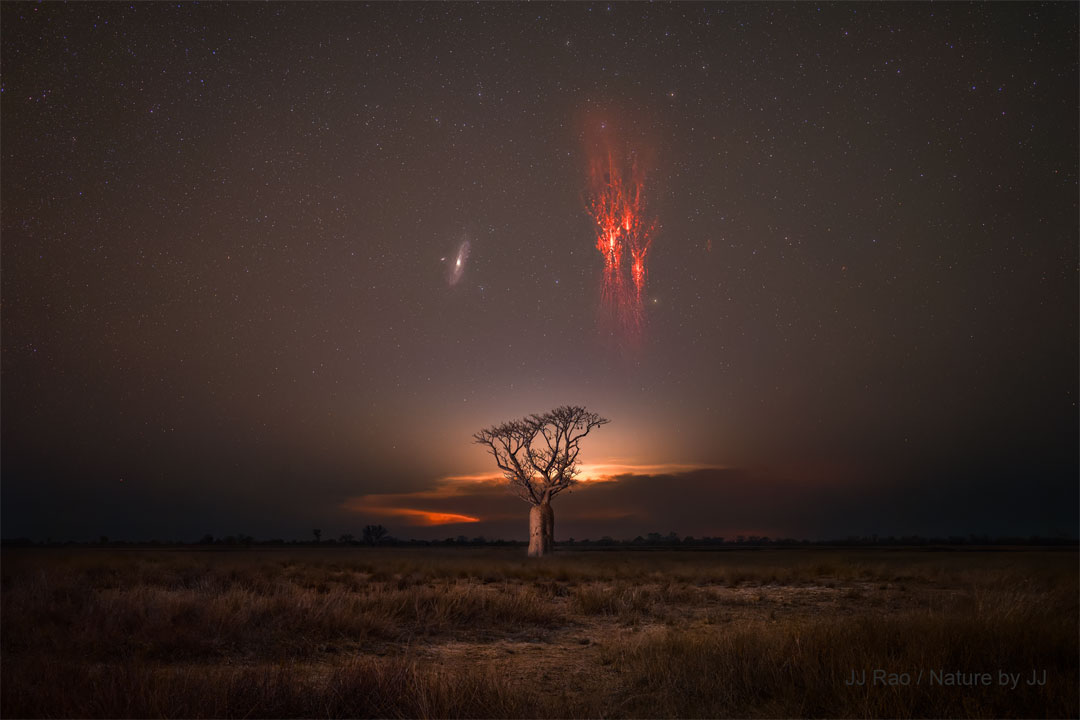
A Galactic Giant and a Fleeting Sky Spirit: Wonders Over Australia

Disclosure: This post contains affiliate links. As an Amazon Associate, I earn from qualifying purchases.

The Full Story

Imagine staring at the night sky and witnessing a cosmic ballet of extremes! This incredible photograph captures not one, but two truly distinct and captivating events. On one side, we have the magnificent Andromeda galaxy, a vast island of billions of stars, so ancient it predates humanity and will continue to evolve for billions of years into the future. On the other, a vibrant red sprite, a type of electrical discharge that briefly flashes high above thunderstorms, hinting at the lively, sometimes mysterious, processes in our own planet's atmosphere. Let's start with Andromeda, also known as M31. It's our closest large galactic neighbor, a sprawling spiral galaxy much like our own Milky Way, packed with an estimated one trillion stars! When you look at Andromeda, you're not just seeing stars; you're looking back in time, as the light has traveled millions of years to reach your eyes. It's on a collision course with our Milky Way, a gentle cosmic embrace that will begin in about 4.5 billion years, eventually forming a new, larger galaxy. This grand cosmic dance highlights the ever-changing nature of the universe on scales we can barely comprehend. Now, shift your gaze to the right, and you'll spot the elusive red sprite. These aren't your typical lightning bolts, which strike downwards from clouds. Sprites are massive, weak, electrical discharges that occur high in the atmosphere, often at altitudes of 50-90 kilometers (30-55 miles), far above the storm clouds themselves. They get their reddish hue from excited nitrogen gas molecules in the upper atmosphere. Because they're so faint, quick, and high up, they're tricky to spot and even harder to photograph, making this capture all the more special. The sheer improbability of capturing both an ancient, distant galaxy and a fleeting, high-altitude electrical event in a single frame is truly remarkable. It's a testament to both the serendipity of nature and the skill of the photographer. The image serves as a powerful reminder of the incredible scales at play in our universe – from light traveling millions of years from another galaxy to a transient atmospheric phenomenon lasting mere milliseconds. Such photographs do more than just dazzle; they open our eyes to the hidden wonders of our cosmos and our planet. They show us that there's always something new and fascinating to discover, whether it's billions of light-years away or just above the clouds. It encourages us to be curious, to question, and to appreciate the intricate beauty that surrounds us, both near and far.

Key Takeaways

  • 1 The photo showcases two vastly different phenomena: the Andromeda galaxy and a red sprite.
  • 2 Andromeda is our closest large galaxy, millions of light-years away, and will eventually merge with the Milky Way.
  • 3 Red sprites are rare, high-altitude electrical discharges that flash above thunderstorms, appearing reddish.
  • 4 The image highlights the immense scale and dynamic activity of the universe, from cosmic to terrestrial.
Hubble Space Telescope Deep Field Poster

Hubble Space Telescope Deep Field Poster

Stunning poster featuring iconic Hubble Space Telescope imagery. Perfect for space enthusiasts.

Check Price on Amazon
*As an Amazon Associate, we earn from qualifying purchases.

💡 Think of it this way:

Imagine looking out your window and seeing a neighboring city of stars (the Andromeda galaxy) while, at the very same moment, a brief, silent, high-altitude lightning flash (a red sprite) dances just above the clouds. It's a snapshot bridging the unimaginably far with the surprisingly close.

How We Know This

Capturing such an image requires specialized long-exposure photography techniques, often using sensitive cameras on stable tripods to gather enough light from the faint Andromeda galaxy. For the red sprite, precise timing and a bit of luck are essential, as these events are brief and unpredictable. The photographer likely had to be in a location with clear skies, minimal light pollution, and an active thunderstorm happening at the right distance to capture both celestial and atmospheric wonders simultaneously.

What This Means

For astronomers, continued observations of galaxies like Andromeda help us understand how galaxies form, evolve, and interact over cosmic timescales. For atmospheric scientists, studying red sprites and other 'transient luminous events' (TLEs) helps us better understand Earth's upper atmosphere, its electrical properties, and how lightning activity influences atmospheric chemistry. For all of us, such images inspire a deeper appreciation for the beauty and complexity of the universe, reminding us to keep exploring and looking up.

Why It Matters

This image reminds us of the incredible diversity of the universe, from galaxies billions of light-years away to unique electrical phenomena happening just above our heads. It sparks wonder and encourages us to look up, appreciating both the vastness of space and the vibrant activity of Earth's atmosphere.

Related Topics

#Astronomy #Galaxy #Red Sprites #Atmosphere #Astrophotography