Webb Telescope Sees Universe's Oldest Star Explosion: A Cosmic Time Capsule!
In Brief
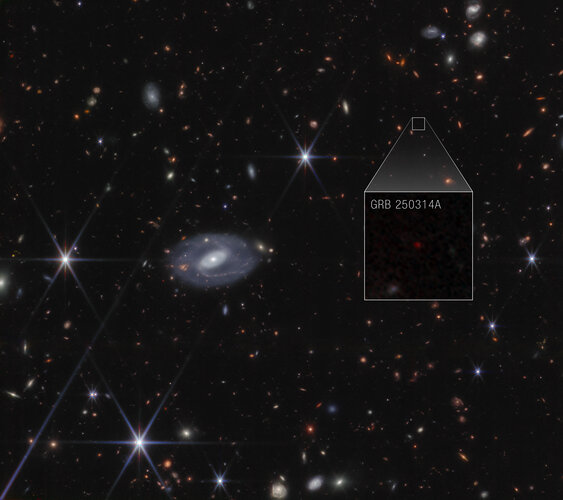
The James Webb Space Telescope has witnessed the explosion of a massive star from when our universe was just a baby, only 730 million years old. This incredible event, a super-bright gamma-ray burst, is the earliest supernova ever confirmed, giving us an unprecedented look at the early cosmos.
The Full Story
Key Takeaways
- 1 Webb detected the most distant and earliest star explosion (supernova) ever seen.
- 2 This explosion, a gamma-ray burst, happened when the universe was only 730 million years old.
- 3 It provides a direct look at the 'cosmic dawn' – when the first stars began to light up the universe.
💡 Think of it this way:
Imagine looking at the universe's baby photo album – Webb just found one of the very first, most spectacular explosive 'fireworks' from that album, shining brightly from billions of years ago!
How We Know This
The James Webb Space Telescope used its powerful infrared cameras to detect the extremely faint and redshifted light from the distant star explosion. Because the universe is expanding, light from far away gets 'stretched' into longer, redder wavelengths (infrared), which Webb is specifically designed to see. This allowed it to peer back in time and capture the afterglow of this ancient event.
What This Means
This groundbreaking observation opens up new avenues for understanding the very first stars and galaxies. It will help astronomers refine models of cosmic evolution, determine how early elements were distributed, and perhaps even discover more 'first light' events, bringing us closer to understanding the universe's origins and its fundamental composition.
Why It Matters
This discovery helps us piece together the ultimate cosmic puzzle: how our universe began, how the very first stars formed, and how they laid the groundwork for everything we see today, including our own solar system and us.