Back to Articles Image Of The Day

Giant Space Blowtorch: Star Spews Jets 19 Light-Years Long!

📖 5 min read 📊 beginner 🏷️ NASA APOD

In Brief

Astronomers have spotted massive jets of energy blasting out from a pair of stars locked in a cosmic dance. These jets, stretching a staggering 19 light-years each, are powered by material swirling between the stars. This discovery gives us a rare glimpse into the complex and violent lives of binary star systems.
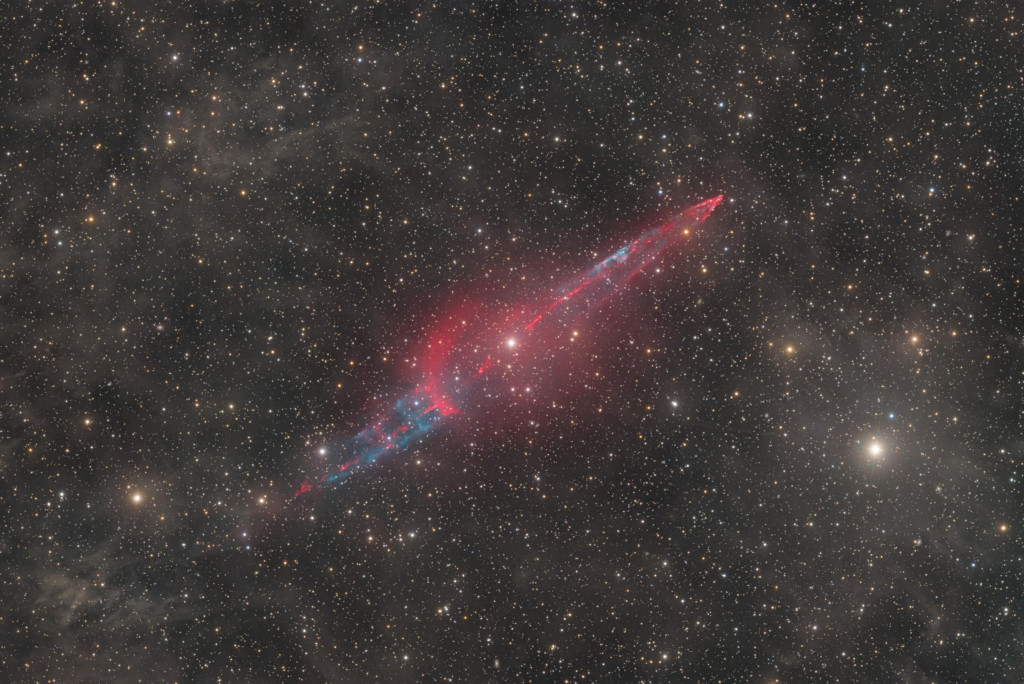
Giant Space Blowtorch: Star Spews Jets 19 Light-Years Long!

The Full Story

Deep within the constellation Andromeda lies a binary star system called KX Andromedae, a pair of stars locked in a gravitational embrace. Recently, astronomers captured an incredible image revealing enormous jets of material shooting out from this system. These jets are not just big; they are absolutely colossal, extending 19 light-years from the central stars in opposite directions. That's a distance almost five times the distance between our sun and the nearest star, Proxima Centauri! KX Andromedae consists of two very different stars: a hot, bright B-type star and a cooler, swollen giant star. The giant star is nearing the end of its life and, as a result, is shedding material. This material doesn't drift off into space, though. Instead, it's pulled towards the B-type star, forming a swirling disk of gas and dust around it known as an accretion disk. The accretion disk acts like a cosmic funnel, feeding material onto the B-type star. However, not all of the material ends up on the star. Some of it is violently ejected outward, propelled by the intense magnetic fields and pressures within the disk. This ejection creates the spectacular bipolar jets that astronomers have now observed. The image showcasing these jets is the result of an incredible effort, combining a staggering 692 hours of observational data. This painstaking process allowed astronomers to capture the faint glow of the jets with unprecedented detail. The jets extend outwards symmetrically from the accretion disk. This discovery is significant because it provides valuable insights into the dynamics of binary star systems and the mechanisms that drive the formation of jets. Studying these jets can help astronomers understand how energy and matter are transported in extreme environments, and how these processes influence the evolution of stars and galaxies. Future studies of KX Andromedae and similar systems could involve using even more powerful telescopes to analyze the composition and velocity of the jet material. This will help us determine the precise mechanisms responsible for launching these jets and gain a better understanding of the complex interplay between stars in binary systems.

Key Takeaways

  • 1 KX Andromedae is a binary star system with a hot B-type star and a cool giant star.
  • 2 The system features spectacular bipolar jets stretching 19 light-years long.
  • 3 The jets are likely powered by an accretion disk formed from material transferred from the giant star to the B-type star.
National Geographic Planisphere Star Finder

National Geographic Planisphere Star Finder

Essential tool for identifying constellations and stars. Perfect for beginners learning the night sky.

$9.95
View on Amazon
*As an Amazon Associate, we earn from qualifying purchases. Price and availability may vary.

💡 Think of it this way:

Imagine two ice skaters spinning together, one pulling pieces of ice from the other. As the ice is pulled, some of it is flung out into the air in opposite directions - like miniature versions of these stellar jets!

How We Know This

The discovery was made using long-exposure telescopic images. Astronomers combined 692 hours of data to reveal the faint jets. They also used spectroscopy to determine the types of stars in the system and the nature of the accretion disk.

What This Means

This discovery will help us better understand the dynamics of binary star systems, the formation of jets in astrophysical environments, and the transfer of mass and energy between stars.

Why It Matters

This discovery helps us understand how stars interact and evolve, revealing the dynamic processes that shape the universe around us. It's a reminder that even seemingly stable stars can engage in dramatic and energetic events.

Related Topics

#binary stars #astrophysical jets #accretion disk #KX Andromedae #astronomy