Back to Articles Space Mission

Hubble Spots a Visitor From Another Star System… Again!

📖 4 min read 📊 beginner 🏷️ ESA

In Brief

The Hubble Space Telescope has snapped another picture of interstellar comet 3I/ATLAS, a cosmic wanderer from beyond our solar system. This icy object, currently 286 million km away, is being closely monitored by astronomers to learn more about the building blocks of other star systems.
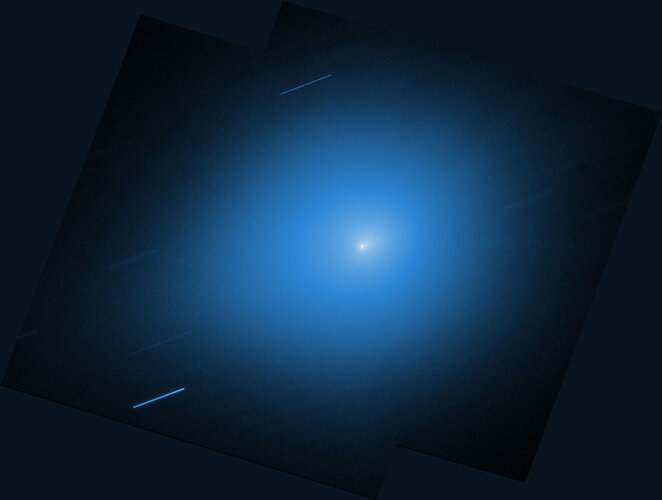
Hubble Spots a Visitor From Another Star System… Again!

The Full Story

Comet 3I/ATLAS, a rare visitor from interstellar space, has once again caught the eye of the Hubble Space Telescope. First discovered in 2019, this comet is not gravitationally bound to our Sun, meaning it originated from another star system and is just passing through. Hubble previously observed 3I/ATLAS shortly after its discovery, and this recent reobservation on November 30 provides scientists with valuable follow-up data. At the time of the latest observation, 3I/ATLAS was approximately 286 million kilometers from Earth. This distance allows Hubble to capture detailed images, revealing characteristics difficult to observe from ground-based telescopes. The images captured by Hubble's Wide Field Camera 3 instrument show the comet as it streaks across the sky. Because Hubble is tracking the comet, the background stars appear as streaks of light in the image. The study of interstellar objects like 3I/ATLAS is crucial for understanding the diversity of planetary systems in our galaxy. Comets are essentially cosmic time capsules, preserving the building blocks of planets from their formation. By analyzing the composition of 3I/ATLAS, astronomers can gain insights into the chemical environment of the star system where it originated. This helps us to compare and contrast our own solar system with others, potentially shedding light on the conditions necessary for planet formation and even the emergence of life. Observing these interstellar travelers also helps refine our models of how comets evolve as they approach and interact with a star. The intense radiation and solar wind can cause comets to release gas and dust, creating a visible coma and tail. Studying these processes in detail helps us better understand the dynamics of comets in general, whether they originate from our own solar system or beyond. Future observations of 3I/ATLAS, and hopefully other interstellar objects, are planned using both space-based and ground-based observatories. These continued studies will undoubtedly reveal even more about the origins and composition of these fascinating cosmic wanderers.

Key Takeaways

  • 1 Hubble reobserved interstellar comet 3I/ATLAS.
  • 2 The comet is a visitor from another star system.
  • 3 Studying interstellar comets helps understand planetary system formation.
Hubble Space Telescope Deep Field Poster

Hubble Space Telescope Deep Field Poster

Stunning poster featuring iconic Hubble Space Telescope imagery. Perfect for space enthusiasts.

$14.99
View on Amazon
*As an Amazon Associate, we earn from qualifying purchases. Price and availability may vary.

💡 Think of it this way:

Imagine a cosmic ice cube that's traveled from a freezer in another galaxy. Studying it is like getting a sample of that distant freezer!

How We Know This

Hubble's Wide Field Camera 3 was used to take images of the comet as it moved across the sky. By tracking the comet, the background stars appear streaked, highlighting the comet's motion and allowing for detailed observation.

What This Means

Further observations of 3I/ATLAS and other interstellar objects will give us a better understanding of the building blocks and conditions in other star systems, as well as the processes that shape comets as they interact with stars.

Why It Matters

Understanding interstellar comets helps us piece together how planetary systems form throughout the galaxy. They carry clues about the composition of distant stars and could even tell us about the origins of life!

Related Topics

#interstellar comet #Hubble #3I/ATLAS #astronomy #space